


The brilliance of Poet Kalidasa, the choreography of renowned Kuchipudi guru Vempati Chinna Satyam, and the direction of Sasikala Penumarthi shine in this remarkable dance drama
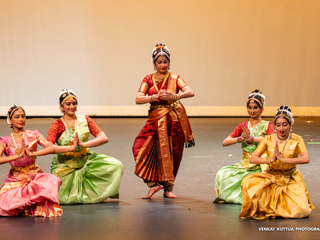
On June 28, at the Clayton County Schools Performing Arts Center, the Academy of Kuchipudi Dance Atlanta staged a remarkable rendition of Padmabhushan Vempati Chinna Satyam’s Abhijnanasakuntalam to a capacity audience of approximately 900. For nearly three hours, attendees were captivated by this world classic authored by the legendary Indian poet Kalidasa, a work rightly celebrated for its unparalleled poetry and incisive prose.
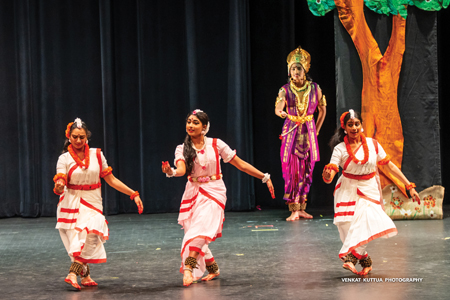 Adapting such a literary masterpiece into a dance drama on stage presents immense challenges. Kalidasawas a wizard of words, wisdom, and wit. His genius lies in his mastery of language and emotion. Transforming his art into the expressive vocabulary of dance demands exceptional skill and commitment. Recalling the anecdote of Goethe, who is said to have danced with Abhijnanasakuntalam atop his head to express his joy at discovering it, I approached this production with anticipation for how such joy and artistry might be embodied on stage.
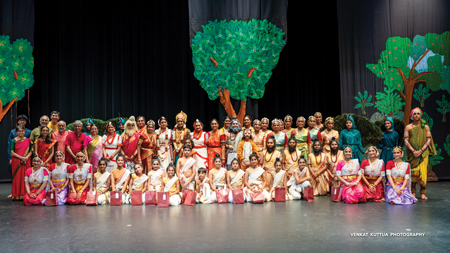
Under the direction of Sasikala Penumarthi, the production remained loyal to the original text, preserving both its quality and its authenticity. This accomplishment is impressive, especially given the collaborative effort of an ensemble cast of nearly 50 dancers across all age groups, supported by nine musicians who provided a seamless musical backdrop. The task, monumental in scale, was further ennobled by its dedication to the four Vedas and to Devi Saraswati, the personification of knowledge. In her prologue, the Director described the work as a gift from her teacher, Sri Vempati Chinna Satyam, and opened with Gurubhyo Namah, honoring the guru-parampara (lineage of teachers) intrinsic to this art form. Such observances reinforce the humility and discipline central to the classical arts.
Plot and Performers
The narrative of Shakuntala, originally rooted in the Mahabharata, was presented with clarity and restraint. Kalidasa’s adaptation, written over two millennia ago, transfor simple history into luminous art through his creative vision. The story follows King Dushyanta, who, while hunting, arrives at the hermitage of Rishi Kanva. There, he encounters Shakuntala and falls in love. Upon learning from her friends, Priyamvada and Anasuya, of her royal lineage, he proposes marriage following the Gandharva tradition, bestowing a ring as a token. After his departure, Shakuntala’s preoccupation leads her to unmindfully neglect the visiting sage Durvasa, whose resulting curse causes Dushyanta to forget her.
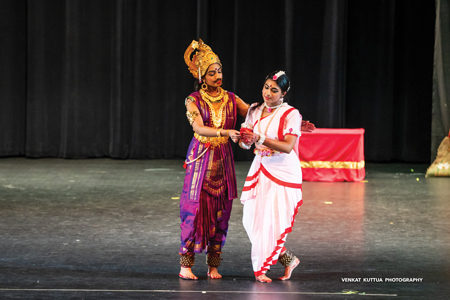 Kanva eventually sends Shakuntala, accompanied by her foster mother Gautami and disciples Saarangarava and Saradvata, to Dushyanta’s court. The scene where Dushyanta, under the curse, fails to recognize Shakuntala is one of heightened emotion and was powerfully portrayed through both dance and expression, particularly the anger of Saarangarava. Kalidasa’s complex exploration of Dushyanta’s conflicted psyche was subtly indicated, though the pivotal confrontational dialogue might have been given more prominence on stage.
Shakuntala, now abandoned and pregnant, is taken by her mother, Menaka, to Sage Marichi’s ashram, where her son, Bharat, is raised. The eventual reunion with Dushyanta, who is moved upon seeing his son, brought the narrative to a deeply satisfying conclusion that resonated with the audience.
Each performer contributed meaningfully to the production. The Director’s ability to marshal a large cast of varied ages to deliver such disciplined performances is a testament to her patience and skill. Sakuntala is a brave and strong character in the play. The many emotions of Sakuntala are well portrayed by the actress. Supporting characters, including Priyamvada, Anasuya, and Muni Durvasa, were particularly memorable. The actor portraying young Bharata, though charming, might have more fully embodied the character’s legendary adventurousness. Notwithstanding minor areas for enhancement, the cast delivered a cohesive and joyous performance.
The motif of the ring—central to the play’s plot device—invites reflection on its universality in global drama, from Rama’s ring in the Ramayana to its prominence in Shakespeare’s The Merchant of Venice. The play’s resolution hinges on the return of Shakuntala’s ring and Dushyanta’s restored memory, inviting audiences to ponder its symbolic mysteries.
The venue itself, while impressive, presented some accessibility challenges due to the absence of sloped entryways. However, these were mitigated by the presence of attentive volunteers and the fact that attendance was free, ensuring an inclusive experience.
Productions such as this serve a vital role in bringing ancient art and themes into the contemporary sphere, inviting younger generations to engage with and inherit these rich traditions. The Academy’s work stands as an inspiring example of cultural preservation and artistic excellence.
- Bhagirath Majmudar, M.D. and Jagannath Sanskrit Scholar.

| Remember, we have new Website Bonus Features that are not in the print magazine. Every time you see the W symbol in the print magazine, you can go to our website to see additional print or audiovisual material! |
|
Submitting your report for consideration in Around Town Please send post event reports for consideration in the Around Town section to AroundTown@khabar.com. Publication of reports is based on several criteria including the volume of reports submitted for a given issue. Guidelines for the reports are on our website at http://www.khabar.com/magazine/around-town/guidelines_for_submitting_reports_to_around_town. Deadline: 15th of each month—for consideration in the following month. However, chances of inclusion are better if reports are received well in advance of the deadline – where possible, e.g. within 3-7 days of the event.
|
Enjoyed reading Khabar magazine? Subscribe to Khabar and get a full digital copy of this Indian-American community magazine.