


Books: Memoirs They Read and Recommended

Writers and avid readers share thoughts on some of their favorite books.
“A memoir is something you know after something you’ve been through,” it’s been said. The word ‘memoir’ comes from the French word mémoire, meaning memory. Such a recollection helps us develop empathy by offering us perspectives outside our own. As evidence of the past, a memoir is timeless, a bridge between generations. Furthermore, it creates one’s legacy, a distillation of vision, wisdom, and inspiration to pass on to others. You may have read and reread a memoir you can’t stop talking about. Here are recommendations that you can add to your list.
Nalini Iyer is a widely published academic who focuses on South Asian and postcolonial studies at Seattle University. Her works include Roots and Reflections: South Asians in the Pacific Northwest.
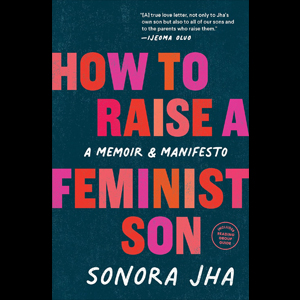
Says Iyer: “I don’t often read memoirs; it’s a genre that is very popular right now and many seem confessional or ultra-focused on personal trauma. I am drawn to memoirs that are much more than the individual’s story, and which offer a trenchant analysis/ critique of society. I am also partial to memoirs that push the boundaries of genre. One such work is Sonora Jha’s How to Raise a Feminist Son: A Memoir & Manifesto.
“Sonora Jha, who is both a friend and colleague at Seattle University, writes about what it takes to raise a feminist son and to combat a culture of toxic masculinity. She writes of being a single mother in the South Asian community that defines family as a heteronormative couple raising multiple children.
As a journalist and media studies scholar, she uses Bollywood and Hollywood narratives with her child from a very young age to engage him in conversations about gender, family, and sexuality. She questions Hindu mythology and caste in the Indian context and racialization in the U.S. that makes young men of color vulnerable. Each chapter also has a set of questions or a to-do list for her readers to explore within the context of their own lives.”
 Kiran Bhat, an Atlanta-raised author with publications in five languages, is a polyglot who has been to around 150 countries. His works include We of the Forsaken World, Girar, and Speaking in Tongues.
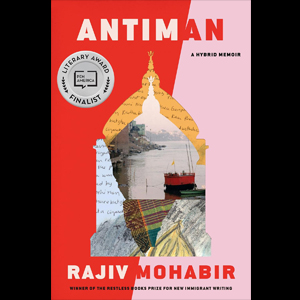
Says Bhat: “Few memoirs reorient the contours of what a memoir ought to be, but if one is in the need to read something very experimental, yet purely desi, I’d heartily recommend Rajiv Mohabir’s Antiman: A Hybrid Memoir. It’s a document of Mohabir’s struggles growing up as a queer in an Indian body as a Guyaneseorigin American. The memoir deals with the themes of family pressures of conforming to a heteronormative world, the difficulties of assimilating in a purely assimilationist world, and the misunderstanding between three very different linguistic cultures. Poetic lines in Bhojpuri interrupt the narration to give voice to Mohabir’s grandmother and his mother tongue. Mohabir travels to Uttar Pradesh, takes Hindi lessons, tries to introduce his family members to romantic male partners. During this time, he faces a lot of resistance and backlash for his decisions. And yet he proudly sticks by them, because he knows that he has nothing else to offer this world other than himself. Antiman is a wondrous read for anyone interested in queerness, defiance, and wants to tryst in between languages, cultures, and literary genres.”
 Deepak Singh, who teaches at the University of South Florida, is the author of Chasing America: Of Lollipops, Night Clubs and Ferocious Dogs and How May I Help You? An Immigrant’s Journey from MBA to Minimum Wage.
Says Singh: “I would like to recommend Family Life by Akhil Sharma. I have read this book several times, and each time it invokes new emotions in me, and makes me feel even more deeply for each character in the book. It is autofiction, not a memoir, but it draws heavily from the author’s own life experiences. Sharma’s brother had met with a tragic accident, and it left him with severe brain damage. The book is about an immigrant’s experience through the eyes of a young boy who is navigating family tragedy, and cultural confusion. What grabbed me was Sharma’s brutal honesty and how he captures the helplessness of watching his brother suffer, the desperation of his parents trying to make a better life in a new country, and the emotional perplexity. The underlying theme of resilience in the face of overwhelming grief gives the book both weight and grace. Sharma doesn’t overexplain; instead, he lets the silences between events speak.
“Reading Family Life offered me a window into both the Indian American immigrant experience and the dynamics within a family coping with the catastrophe. Sharma’s insight into how trauma echoes through each member of the family feels deeply personal and relatable to me. This perspective made me think about my own emotional resilience and the complicated ways families express love and grief.”
 Ranjani Rao, who lived in the U.S. for many years, is a scientist and writer based in Singapore. She is the author of Rewriting My Happily Ever After: A Memoir of Divorce and Discovery.
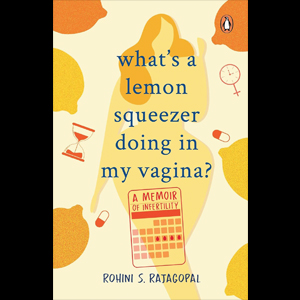
Says Rao: “What’s a Lemon Squeezer Doing in My Vagina by Rohini Rajagopalan is a memoir of infertility that transported me to a time and place where I had experienced many of the medical interventions and procedures that she describes so vividly in her witty, yet moving book. In her detailed chronicle, Rohini describes what happens at the personal, psychological, and marital level when a couple commits to the harrowing journey that is infertility treatment where the burden and consequence of the choice is disproportionally allocated to the woman. Rohini uses words that make us uncomfortable, explains unfamiliar terms, and takes us into a territory that most couples who worry about birth control may not understand. Rohini’s selfdeprecating humor makes you root for her and her no-details-spared 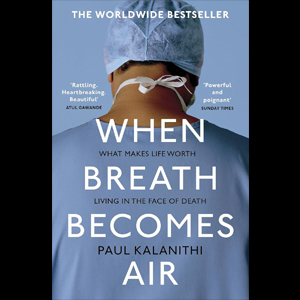 descriptions make you want to hold her hand as her losses mount and her dedication to the cause occasionally falters. A must-read for anyone undergoing infertility or is curious about the difficult journey to motherhood that some women face.
“When Breath Becomes Air by Paul Kalanithi is my go-to memoir when I find myself getting into complaint mode. The author, a brilliant neurosurgeon on the threshold of embarking on the glorious career he had worked so hard for, is handed a dire diagnosis of metastatic lung cancer. This memoir, written in the final months of his life, is a reminder for all of us to answer the fundamental question: What makes life meaningful enough to go on living? His beautiful writing made me conclude that all life is beautiful and sacred, whether it belongs to the brilliant surgeon wielding the tools to heal a human or the helpless patient who turns over his fate to the physician. With Kalanithi, we get to see both sides in his brief life. This book is not a chronicle of medical treatment but a meditation on the human aspect of living.”
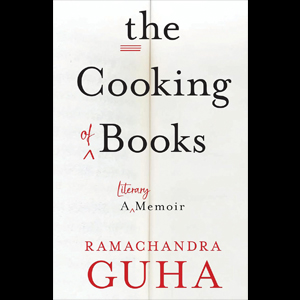 Recommended by Khabar magazine: Bestselling Indian historian Ramachandra Guha’s literary memoir, The Cooking of Books, out in paperback, may remind one of memoirs such as the late editor Vinod Mehta’s Lucknow Boy. But Guha’s book is really about a literary friendship— and as a bonus, readers get fascinating, behind-the-scenes glimpses of the arcane publishing world. The friend is Rukun Advani. A brilliant yet quirky and reclusive editor and publisher, Advani gained admiration for raising publishing standards in India. Guha’s first meeting with Advani, when they were students at St. Stephen’s College, Delhi, wasn’t auspicious. The author is self-deprecatory, and often witty, as he traces the evolution of their unlikely friendship over the decades, contrasting the initially callow and awed Guha with the cerebral and talented but intimidating Advani.
Admittedly, the subject matter is a little highbrow—fans of Beethoven, for instance, will find a kindred spirit in Advani—and the book may appeal more to writers or aspiring writers. Nevertheless, Guha is such an accessible and polished writer, with a knack for bringing people to life on the page, that anybody interested in friendships is likely to enjoy the memoir. He rarely met Advani, and intriguingly, much of their interaction was via letters and email, giving Guha his archival material. But that didn’t 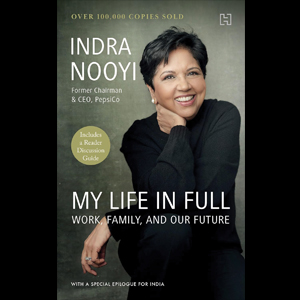 make their long-distance friendship less profound. Calling his book a tribute to a “remarkable (and remarkably self-effacing) editor,” Guha declares, “In an author’s life, the person next in importance to his or her romantic partner is his or her editor.”
Bharti Kirchner: And now my personal favorite, Indra Nooyi’s My Life in Full: Work, Family, and Our Future. From 2006 to 2008, Nooyi was the chair and CEO of PepsiCo, a period during which there existed far fewer women business leaders than there are today. This is especially true for those of color. Nooyi’s memoir guides us through her childhood in Chennai, education at Yale, marriage and birth of her children, and her rise as a corporate professional despite many hurdles. She even managed to share a household with her mother-in-law. Hard work and adjusting to situations epitomize Nooyi. So does learning from others. And she remains mindful of those who will struggle to follow the same path.
Bharti Kirchner is the author of nine novels, including Shiva Dancing and Darjeeling, and four cookbooks. Her Murder at Jaipur: A Maya Mallick Mystery is the third novel in her detective series. Her work has been translated into German, Dutch, Spanish, Marathi, Thai, and other languages. She lives in Washington state.
Enjoyed reading Khabar magazine? Subscribe to Khabar and get a full digital copy of this Indian-American community magazine.