


Books: Mother Mary Comes to Me (Scribner) – a memoir by Arundhati Roy/ Indian Country (Crown) – a novel by Shobha Rao

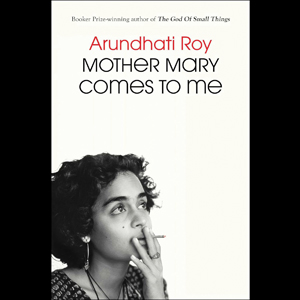
Mother Mary Comes to Me (Scribner) – a memoir by Arundhati Roy
Reviewed by PARUL KAPUR
Arundhati Roy, winner of the 1997 Booker Prize for her bestselling first novel, The God of Small Things, and a committed critic of the Indian state, turns a sharp eye on her own life in Mother Mary Comes to Me. The horrifying star of this compulsively readable memoir is Roy’s violent, abusive, occasionally charming, severely asthmatic, and narcissistic mother, Mary Roy, who rises from penniless divorcee to admired educator to feminist icon in India. Unafraid to battle, she wars with her brother over family property. When the Supreme Court rules in her favor, striking down patriarchal inheritance laws, Mary Roy is celebrated as the change agent bringing Christian women in Kerala equal rights to their father’s property.
Roy, the daughter, never dares to stand up to her volatile mother. A monster who describes to her daughter the ways she tried to abort her, who sometimes throws her child out of the car to sit on the road, who daily hurls dishes and insults. The daughter escapes to Delhi and, years later, discovers her anger and her voice in excoriating the Indian government for its treatment of the dispossessed—whether villagers threatened by the Narmada Dam project or murderous Naxalite rebels patrolling Chhattisgarh’s forests—in her many volumes of political reportage. It’s surprising when this fierce adversary of the state describes herself in a selfdeprecating moment as being constructed from the “debris” of her mother’s terrifying moods. A rare instance when Roy allows the reader to come close to her emotionally. Because—as vividly as she depicts her turbulent childhood, her affair with a married man that ends in his wife’s sudden death and her reluctant installation as a memsahib in his bungalow, and the astonishing birth of her literary masterpiece—she grew up hiding her vulnerabilities from the monster at home. In this book, we glimpse the intimate silence and public outrage that define Arundhati Roy.
Atlanta-based Parul Kapur’s debut novel is titled Inside the Mirror. She won the 2025 Georgia Author of the Year Award (First Novel category) and the AWP Prize for the Novel, among other honors.
Indian Country (Crown) – a novel by Shobha Rao
Reviewed by GIRIJA SANKAR
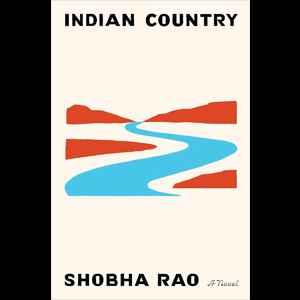 Janavi, young and just out of college, finds herself married to Sagar, a hydraulic engineer living in the U.S. He was originally betrothed to her sister, Rajni, but as fate would have it, Rajni fell in love with Pavan and begged Sagar to ask for Janavi’s hand instead. Janavi, displaced and despondent, is torn away from a job she loved, a city and river she cherished, and the family she adored. She now finds herself in the small American town of Mansfield in Big Sky Country. Sagar, energized by his job, is working to dismantle a dam on the Cotton River in Custer County, Montana. Janavi and Sagar— named after water bodies, one a mighty river and the other an ocean—have only each other now.
Janavi finds life in Mansfield humdrum even as Sagar throws himself into the engineering project. He senses opposition to the dam’s removal but cannot pinpoint its source until Renny, a Native American co-worker, is found drowned in the river. Janavi, adrift in a strange new land, finds renewed purpose in avenging Renny’s death and in supporting Ophelia, a young girl left orphaned. In Ophelia, Janavi sees the children she once worked with on the streets of Varanasi, supported by the NGO she had devoted her life to.
Rao begins and ends the narrative with the allegory of the older brother, the younger brother, and the porcupine—an origins story of the Cotton River. Throughout, characters exchange folklores about their native lands and rivers. Rao weaves historical anecdotes and ghost stories from both the Cotton and the Ganges rivers into the linear thread of Sagar and Janavi’s lives. We meet Teddy and Nell, Radhika, Leela, Avni, and Caroline—figures whose lives are shaped by harsh landscapes and sometimes ended by the forces of the river. These vignettes carry the reader across timelines and geographies, connecting seemingly disparate lives through shared currents of loss, longing, and endurance.
Both Janavi and Sagar are no strangers to tragedy. Sagar’s childhood recklessness left his brother Sandeep with lifelong impairment after a fall into the river. Janavi lost her mother early, and her memory is forever tied to the water they both revered. Sagar, obsessed with shipwrecks and Spanish galleons, seeks escape and redemption in rivers. Eventually, he does discover something submerged in the Cotton River—but it is not gold, only buried truths.
Throughout the novel, rivers function as far more than scenery—they are both witness and judge. The Ganges and the Cotton River become repositories for memory and grief, agents of justice and silence. A dip in the Ganges is believed to be auspicious; death along its banks is seen as auspicious. Similarly, the Cotton River both cradles and claims life. Lives begin, transform, or end by the water’s edge. The river demands sacrifice, but it also offers rebirth.
Rao also probes the burdens and erasures carried by women, especially immigrant women, across generations. Janavi’s resistance, small yet steadfast, becomes a radical act of reclamation.The parallel between Indian immigrants and Native Americans may at times feel overly scripted, yet it provokes questions: Who belongs to a place? Who decides whose grief matters? What does it mean to build a future on someone else’s sacred ground? Rao’s decision to place her Indian protagonists in a region soaked in Native American history is no coincidence. While some parallels may seem surface-level, the novel navigates shared experiences of colonized peoples—dispossession, cultural silencing, and spiritual rupture. The dam removal project becomes a metaphor for larger processes of excavation—of histories, of guilt, and truth.
Girija Sankar, a freelance writer based in the Atlanta metro area, works in global health.
Enjoyed reading Khabar magazine? Subscribe to Khabar and get a full digital copy of this Indian-American community magazine.