


Fiction: All My Daughters

During a late-afternoon stroll through the bustling streets of Mumbai, punctuated by stops at Starbucks and Café Madras, a grieving father from Atlanta finds solace in his encounters with strangers.
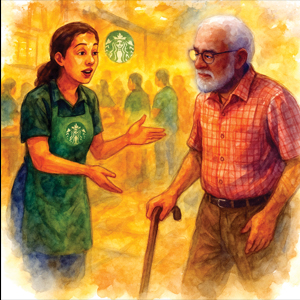
As I stood, seventh in line, at that busy Starbucks location in Mumbai, I marveled at how easy it was to lose my bearings and think I had just stepped into one of these stores near my home in suburban America— the same lateral layout, the same green aprons of the staff, and the identical counters displaying the all too familiar scones, croissants, and savories. Only a couple of offerings, such as the Tandoori Paneer sandwich and the Murgh Kathi roll, served as reminders that I was in India. Oh, and not to mention that just outside the glass doors behind me was all of India—in your face: the mad cacophony of late afternoon traffic made up of a chaotic mix of bicycles, scooters, motorbikes, rickshaws, cars, taxis, commercial vans, and a sea of pedestrians on the footpaths, spilling over onto the streets.
I mused about how I appreciated both the tranquility of my hometown on the outskirts of Atlanta, with its many forest-like parks, and the intense, highpitched energy of Mumbai’s bustling streets. It’s interesting how a heartbreak can invoke the philosopher in one, as I contemplated how serenity and solitude, along with the dynamic exuberance of controlled chaos in crowds, can serve as the ida and pingala of prana, which is said to be so crucial for balance and sanity.
“Uncle, why don’t you take a seat? I will send one of my baristas to take your order.” I guess the head barista must have seen me walking with a limp, using a walking cane, and squirming in pain as I stood impatiently in line. The acute bursitis that had inflamed my right groin and hip joint, likely triggered by a rigorous hiking trip with my nature-loving nephew and his wife, had me impaired for the time being.
I was touched by the barista’s gesture, but… “Uncle”?!
By then, I should have been used to that term of endearment. I had been referred to as such a few times during my two months in India. My greying hair and goatee had earned me a “status” that I was only slowly getting used to.
 There was something about the barista’s positive vibe and thoughtful gesture that reminded me of better times. It provided a rare, brief respite from the perpetual cloud of overwhelming grief that had become my constant companion since that fateful day, a little over three months back, when the lamp of my life was tragically extinguished by a heartless God.
I have tried to get on with life since then. In acts of masquerade, I smile at strangers and sometimes even crack a joke. I make half-hearted attempts to find meaning and joy in everyday life, but that does very little to alleviate the persistent background of darkness and angst that had—uncharacteristically—become my reality. Before that dreadful day, simple, quotidian pleasures used to be markers of a joyous life centered around our nuclear family: my wife, our only daughter, and me. Now, these indulgences have become feeble attempts to puncture the melancholy balloon that envelops me for most of my waking hours.
This afternoon, stepping into Starbucks was certainly not part of the plan. The only reason I had done so was to relieve my overburdened bladder that had been crying out for relief. I had been wandering around the city of my childhood, amazed by the many changes that had occurred over the decades I had been away. But even after all these years, finding a public restroom in the city remains just as daunting as ever. After anxiously checking a few likely places with no luck, spotting the Starbucks seemed godsent. I made a mad dash to the “washroom,” desperately hoping that it wouldn’t be like New York City, where restrooms are locked and accessible only to those privy to the combination code. Thank God for small blessings!
When I came out, feeling relieved and refreshed from the cold-water splash on my face and hair, the only reason I got in line to order was a sense of appreciation for the use of their clean and modern facilities at a time of dire need.
As I settled into one of the inviting lounge sofas, I found myself surrounded by fashionably dressed youngsters—a group of excitable friends chattering in English punctuated with American slang, a studious looking chap engrossed in his laptop screen, and a young couple, perhaps out on a first date—judging by their staccato conversation and nervous laughter.
With my wrinkled, checkered shirt tucked into Walmart-bought cotton trousers, I felt out of place among trendy youngsters. Yet, the thought that came to mind was, “Not bad… after close to 40 years in the States, I could still pass off as a Mumbai local, even if only as an old-fashioned ‘Uncle.’”
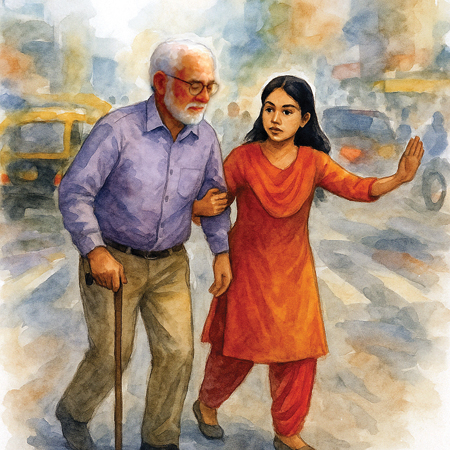
After finishing my iced Flat White, I stepped out onto the street. Not being used to the limp and walking cane, I struggled to negotiate the impossibly busy intersection. I stumbled over an uneven patch, almost falling into the path of an oncoming taxi—saved only by the strong grip that yanked me back by my shirt. “Careful, Uncle!” the young woman who had come to my rescue half pleaded, half chided. She quickly took a doubletake once she had a chance to size up the situation, seeing me with the cane, and offered, “Come, I will help you cross.” Before I could respond, she gently grabbed my wrist and led me through the maze of vehicles. For a young lady of her diminutive size, she exerted a commanding presence over the traffic. With a firm hand gesture, she ordered the slow-moving traffic to stop—or at least slow down further—as we crossed the street. “Thank you, Beta,” I blurted out.
I appreciated her thoughtfulness, though I felt a twinge of annoyance at needing help to cross a street in the very city where I had once aced busy intersections like this one. Before she bolted off to wherever she was headed, she flashed a wide smile. In that instant, she seemed to me both—Durga, the divine feminine protector, and like my own daughter, caring for her old man.
The Starbucks barista had managed to create a minute crack in my cocoon of gloom that had enveloped me since that dreary day. And now, it was my petite guardian angel, who had saved me from a hospital bed, if not worse, who had managed to widen that crack, mitigating the melancholy just a bit more.
I continued to where I was headed before the unplanned Starbucks stop. The plan was to kill some time sipping South Indian filter coffee before meeting a friend for dinner later in the evening. Among the many enticing choices at the famous Matunga Circle, I chose Café Madras. In striking contrast to the modern feel and ample space of the Starbucks, this place was storied, compact, and packed. Its walls, decked with black-and-white and sepia photos, as well as mementos from a bygone era, spoke to its legacy that dates to the pre-Independence era. The heady aroma of the idli-dosa-sambar, so characteristic of a classic South Indian restaurant, was just as I remembered from my childhood days.
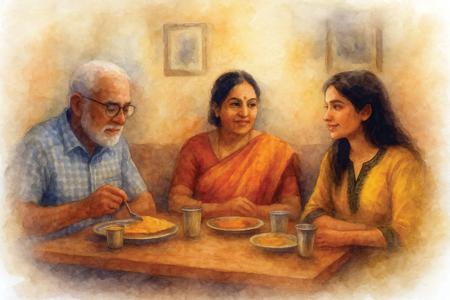 “There’s a 25-minute wait,” I heard the host tell a family. Then he turned to me and asked if I was dining alone. When I nodded, he directed me to a table for four along the wall, already occupied by two women—a middle-aged lady in a saree and a younger one in jeans, paired with a bright-gold silk kurti.
I had almost forgotten about this discomforting practice of such establishments—having you share your table with complete strangers during rush hour. As I settled into the tiny bench seat next to the middle-aged lady, I had to set aside my American sensibilities about personal space. We exchanged a quick nod and a smile and then went on to behave as the perfect strangers that we were—they returned to their conversation, and I began scanning the menu.
As busy as the restaurant was, it took a while for the waiter to come for my order. In the meantime, inadvertently—and inevitably—I was sucked into each word of the conversation between the ladies, wondering if they were concerned or even conscious about it. Didn’t seem so. I remembered that this has been a quintessential trait of Mumbaikars: not giving a hoot about who is listening in on their personal conversations. In the packed suburban trains of this Maximum City, a million soap operas play out through countless conversations between friends and family—for anyone and everyone to tune in if they cared to.
In the few minutes of being the fly on the wall, I learned that the older woman was the mausi of the younger one and that they were planning the wedding of the mausi’s son. Ha, I now knew more about the guest list and the caterer than perhaps the bride and groom did at that point: Dadu was insisting on too many guests that the groom didn’t even know well enough… and that the whole family was invited by the caterer for samplings.
When the waiter finally came to take my order, I decided to indulge in a pan poli along with the filter coffee. It was only after I had taken a couple of bites of my delicacy that the young woman broke the ice, “That’s interesting, Uncle!” (There it was again!). “We come here often, but I was not aware of this dish. Is it a dessert?” Yes, I said, as I described the delightful, mildly sweet dessert made of jaggery, banana, coconut shavings, saffron, and cardamom, all wrapped in a steamed banana leaf. “You don’t know what you have been missing,” I said emphatically. Then, impulsively, I offered, “If you don’t think it is awkward, do try a spoonful from mine.” She didn’t miss a beat as she used her spoon to cut out a chunk of the goodness from my plate and sampled it, following it up with a shriek of pure delight. I then picked up a fresh new spoon from the table, cut another chunk, and offered it to the mausi. She too couldn’t contain her excitement, as she exclaimed, “Oh my God, ye to laajawab hai!”
In just a few minutes, two more filter coffees and two more pan polis landed on our table. The young woman immediately proceeded to cut half of her poli and, without asking me, placed it on my plate. “Uncle, we almost finished yours, so please have this.” For the next 30 minutes, I was no longer the stranger eavesdropping on a family conversation, but rather very much a part of a new conversation, as we exchanged a bit about ourselves. “Arrey, I would have never guessed you have been living in America for so many years. Your Hindi is pakka Mumbaiwala.”
She then added ruefully, “You remind me of my father. He passed away three years back.” In doing so, she struck a chord in me, and I couldn’t help but gently touch her hand, saying, “The feeling is mutual.” By the time I finished telling them the sad saga of my loss, I was drenched in a strange mix of pathos, coupled with a simultaneous feeling of solace and renewal.
When I stepped out onto the street after parting with the ladies, I suddenly felt a deep sense of peace. The unbearable sadness that had become a part of me since my wife and I lost dearest Dia, our 19-year-old daughter—and the light of our life—to cancer, finally loosened its grip that evening. “They are all my daughters,” I genuinely felt.
Parthiv N Parekh is the editor-in-chief of Khabar. Illustrations credits: DALL-E (Via ChatGTP). This short story was first published on www.kitaab.org.
Enjoyed reading Khabar magazine? Subscribe to Khabar and get a full digital copy of this Indian-American community magazine.