


Food & Dining: The Top Chef from Tamil Nadu

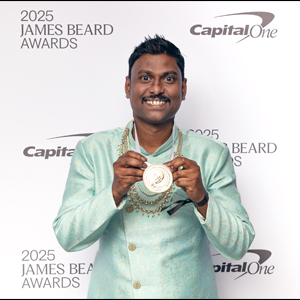
Vijay Kumar is an executive chef and partner at Semma, New York City’s most acclaimed Indian restaurant. Kumar, who won a 2025 James Beard Award, spoke to Khabar about his journey from rural poverty in India to metropolitan stardom.
[Left] Photo Credit: Galdones
Semma, the first Indian restaurant to top The New York Times 100 “Best Restaurants” list, is located in Manhattan’s Greenwich Village, where literary legends like Mark Twain and E.E. Cummings once lived, and where Mabel Dodge Luhan once presided over her salon of writers and radicals such as John Reed and Emma Goldman. Semma, with its 44-year-old super chef Vijay Kumar, is as radical in its way as Dodge Luhan’s salon was back in the early 1900s.
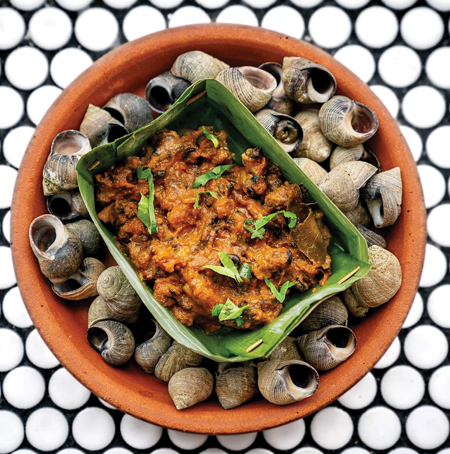
Building on the vision he brought with him from California, where he was chef at South Indian restaurants—Dosa in San Francisco and Rasa in Burlingame—Kumar was inspired by the idea of cooking the kind of rural Tamil food (“humble food,” as he puts it) found in homes like his mother’s in Natham in the Dindigul district of southern Tamil Nadu. Food like nathai pirattal (snails), for which he’d sometimes forage in paddy fields as a boy, and which he associated with poverty. In culinary school in Chennai, he learned all about escargot, the snail dish revered by the French. It was a revelation. His “poverty” was French wealth on a dinner plate.
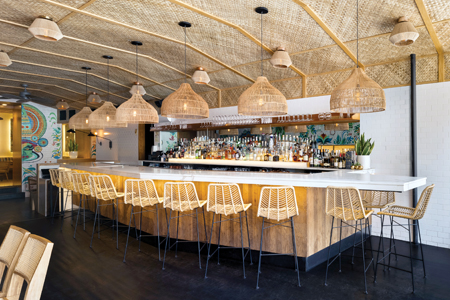
[Right] Photo Credit:Will Ellis
The nathai pirattal isn’t something that diners expect to see in an Indian restaurant, but it’s a signature dish at Semma. Zooming with Kumar makes one rethink the stereotype, born of film and literature, about the inevitable corruption of the poor country boy who suddenly makes it in the Big City. But Kumar tends to be self-effacing, even when referring to the 2025 James Beard Award he won for New York state’s Best Chef. “It’s a blessing,” he says. That’s a word he uses often, Kumar admits. Did the thought of becoming a top chef occur to him before coming to America? “Never. I thought of just one thing, whether as a chef or a student or anything else: being true to myself and putting myself out 100% without expecting anything in return.”
Much is expected of him now. He is besieged by admirers, interviewers, and associates trying to keep intact Semma’s lofty place in New York’s ever-changing restaurant world. For all that, Kumar draws strength from a stability that is homegrown, slow-paced, and delicious. “The food I grew up on,” he stated at the James Beard Award ceremony, “the food made with care, with fire, with soul, is now taking the main stage.”
 I ask him to talk about his childhood. “I always remember mornings in Natham. They were quiet with roosters crowing, kolams being drawn, and the smell of wood smoke in the air. Everything was simple and close to the land.” Including his bare feet that took him two kilometers to school in the morning heat. The boy from Natam has never left him. “To give that piece of myself a James Beard award was something I never imagined.”
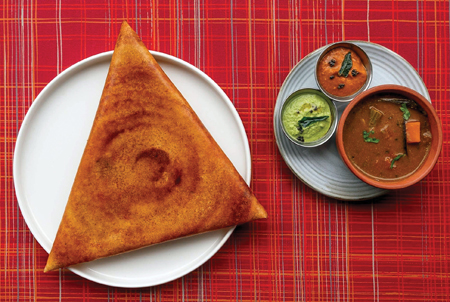
[Left] Gunpowder Dosa (Credit: Paul McDonough)
What does it mean to put “soul” into the cooking of food? “Cooking with soul is putting your full self into the dish,” Kumar notes. “And taking the care, patience, and respect for where the food comes from. That’s what makes the food connect. That’s what people taste.” A dash of Tamil film culture was originally thrown in at Semma. Silk Smitha, the steamy, prolific star of South Indian movies of the ’80s and early ’90s, had a cocktail named after her, described in the menu as a being a “cardamom infused cocktail,” with red peppercorn and agave.
Semma, founded in 2021, is a marriage between chef Kumar and New York-based Unapologetic Foods, headed by two radical Indian entrepreneurs, Roni Mazumdar and Chintan Pandya. Unapologetic champions “heritage cuisines.” Its mission statement reads: “We celebrate complexity, honor culture, and create space for voices that have long gone unheard.” Kumar’s dishes at Semma were “a return to coconut and gunpowder (a reference to its gunpowder dosas), to its fermentation and fire.” A return to what was always there.
Unable to afford engineering school, Kumar headed to a culinary school in Chennai. Unknown to him, but because of him, that school made it possible for poor young South Asians to dream of careers as chefs anywhere in the world. Kumar’s first cooking job was at Chennai’s Taj Connemara. “They had me cooking Italian, French, and American food. Not Indian. It was not considered that fancy,” he points out.
 In 2007, seeking a better life financially, Kumar journeyed to America. He worked briefly at an Indian restaurant in Virginia before moving on to California the following year. He would live thirteen years on the West Coast. For the first six years, he worked first as sous chef, then head chef at Dosa. He quit Dosa to become head chef for the recently opened Rasa. It was at Rasa that Kumar’s career began to take off Rasa went on to become California’s first Indian restaurant to garner a Michelin star. In 2016, the restaurant critic for the San Francisco Chronicle describ-ed Rasa as “clearly the best restaurant I have found in the Bay Area.”
[Right] Nathai Pirratal (Credit: Paul McDonough)
Kumar’s one complaint with some of his California customers, and their attitude towards Indian food, was that they expected it to be cheap. The lack of cultural esteem bothered him. Semma is not, as Roni Mazumdar says, “the cheapest restaurant in town, but you can afford to eat here, as a New Yorker, twice a week.” Actually, the prices are quite reasonable for a West Village restaurant. The gutti vankaya (stuffed eggplant) may cost you $38, but the nathai pirattal is $27, while the gunpowder dosa and roadside kalan (mushrooms) can both be had for $21. In a Zoom interview with Shonali Muthalaly of The Hindu, Kumar whipped out his smartphone and showed Muthalaly a line of people stretching down Greenwich Avenue, waiting for Semma to open.
“We have been busy from day one,” Kumar says. He makes it sound easy. For one who has journeyed so far, from rural poverty to metropolitan success, maybe it is easy. He sees it as a blessing.
Freelance writer Robert Hirschfield is the guest columnist this month. Food & Dining is hosted by Sucheta Rawal, an award-winning food and travel writer who has traveled to over 120 countries across seven continents, experiencing the world through her palate. She inspires people to travel more meaningfully and sustainably through her nonprofit, Go Eat Give. Find her @SuchetaRawal
Enjoyed reading Khabar magazine? Subscribe to Khabar and get a full digital copy of this Indian-American community magazine.