


My Turn: An Indian Voice in an American Classroom

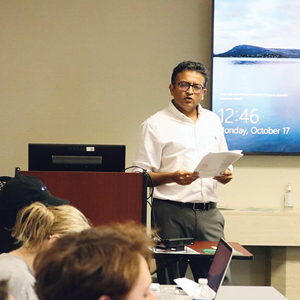
DEEPAK SINGH is an immigrant teacher who speaks with an Indian accent.
I’ve been teaching creative writing to undergraduate students at a public university in Florida for the last five years. And it is rather ironic that I find myself in this role.
In my early years in the U.S. when I worked on the sales floor, customers would often insist on speaking with “someone who speaks English,” implying I did not. Some of my colleagues also told me if I wanted to be successful in this country I needed to learn to speak English well.
[Left] Deepak Singh teaches at the University of South Florida in Tampa.
Now, when I step into a classroom full of students who grew up in the U.S.—students from some of Florida’s top high schools and among the brightest at the university—I’m acutely aware that I didn’t grow up speaking English myself. Even though all my education in India was in English, it still strikes me that, for most of my students, English is the only language they use in daily life.
I’m an Indian immigrant, and I speak with an Indian accent—something I can never hide. My students, on the other hand, are Americans with American accents. They carry their own assumptions about someone who looks and sounds like me, just as I hold my own preconceptions about them. What they don’t see is how desperately I try to steady my nerves during the 75 minutes I stand before them. They don’t know how carefully I’ve practiced pronouncing names like Caitlin, Zachary, Angelina, and Walter.
I’m not surprised by how some of my students react to me on the first day of class. I have a sense of what might be going through their minds. And whether or not they’re actually thinking what I suspect, it still affects me. I become stiff; I slur my words or speak too quickly. I try too hard to sound American, to appear relaxed and confident—even though my legs are shaking. I overcompensate. I carefully plan every minute of that first class, writing everything down on a small piece of paper divided into ten-minute blocks. Yet despite all this preparation, I still forget half of what I meant to cover and end up dismissing the class at least fifteen minutes early; my nerves get the better of me.
I sometimes ask myself why that is.
This has very little to do with what Americans think of folks who speak English with an accent but has a lot to do with how my own parents thought of the English language. English was the language of power and authority in India, especially in the India I grew up. Folks who could speak English fluently belonged to the elite class. This is one of the reasons why my mother insisted on sending me to English medium schools. Just being able to speak English fluently put me in the top five percent of the population in India. I could use the language to my advantage in many ways: socializing, impressing friends and relatives, acing job interviews, getting top jobs. With a good command over English, I walked with an air of superiority and confidence.
Now, despite my master’s degree in fiction from a top American university and work published in leading American outlets, I feel nervous walking into a classroom full of American students. The roles have reversed: here, I am the outsider whose accent marks difference rather than status—and it clearly affects my confidence.
As the weeks go by and the semester progresses, I try to help my students understand something I couldn’t fully grasp growing up: that fluent English—or speaking English without an accent—doesn’t automatically equal intelligence. And that telling a compelling story doesn’t require a certain accent at all. Over time, they also come to see that being different—growing up in another culture and speaking a different language—isn’t a hindrance to writing an interesting story, but rather an advantage.
Even now, after teaching for several years, at the start of every semester, I feel a familiar nervousness settle in. Facing a new group of students and having to prove myself all over again can be draining. Yet, by the time the semester ends, I often find that the experience has taught me as much—if not more—about myself than I have taught my students.
Deepak Singh is the author of two books: Chasing America: Of Lollipops, Night Clubs and Ferocious Dogs and How May I Help You? An Immigrant’s Journey from MBA to Minimum Wage. His writing has appeared in outlets like The New York Times, The Atlantic, The Boston Globe, NPR, and PRI’s The World. He holds an MFA in fiction from Boston University.
Enjoyed reading Khabar magazine? Subscribe to Khabar and get a full digital copy of this Indian-American community magazine.