

Perspective: When the Vice President’s Faith Becomes a Public Matter

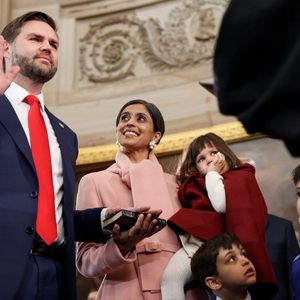
JD Vance’s hope that his Hindu wife will “come to Christ” may seem personal, but when voiced from the nation’s second-highest office, it signals something deeper—a challenge to America’s pluralism and to families who live interfaith love every day.
When Vice President JD Vance told an audience at a Turning Point USA rally, held in October, at at the University of Mississippi that he hopes his wife, a Hindu, will one day “be moved by the same thing that I was moved by in church,” it was more than a peek into their marital relationship. It carried a weight that should give every American—especially those in interfaith families—pause.
Let me begin with empathy. Faith is personal. Every believer wants to share what has transformed their life. Indeed, after his initial statement caused controversy, Vance said on Friday that “beliefs have many consequences, one of which is that we want to share them with other people.”
But this wasn’t any believer. When a sitting vice president makes this kind of statement at a political rally, that private conviction is amplified through the power of public office. It reverberates through a culture already grappling with whether Christianity alone defines morality, patriotism, and family values. It reinforces an old and persistent story about belonging in America: that wholeness, even love itself, ultimately depends on coming to Christ.
Americans, who are Hindu, Jewish, Sikh, Buddhist, and Muslim, will hear Vance’s hope as a public reminder that only one faith is really American.
I write as someone who has lived the life Vance describes, but in a different way. For 26 years, I’ve been married to John Bartlett, an Episcopalian. I am Hindu. Together, we have built a life where faith is not a contest, but a collaboration.
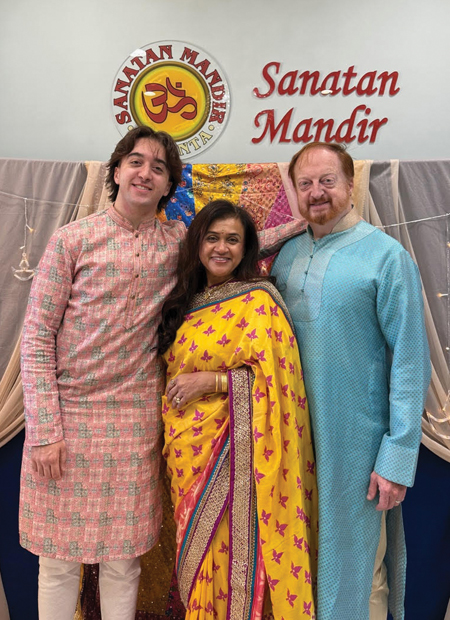
For 26 years, I’ve been married to John Bartlett, an Episcopalian. I am Hindu. Together, we have built a life where faith is not a contest, but a collaboration,” says the author, seen here with her husband and son.
That collaboration began at our wedding, where, instead of alternating rituals like a game of ping pong, we blended Hinduism and Christianity in a single, seamless ceremony, with my Hindu uncle reading a passage from the Bible’s Book of Isaiah describing a bridegroom decked in a garland. The verse, in that moment, felt both deeply Christian and unmistakably Hindu.
We celebrate Christmas and Diwali. We sing carols and chant mantras. In our living room, the cross and a statue of Ganesh sit side by side, not as competing symbols, but as companions in a shared search for meaning. Our coexistence is not confusion; it is clarity born of love. Faith, at its best, expands the human heart.
Vance’s words echo a deeper assumption: that Christianity is the norm in America, which oversha-dows other faiths. When he says he “hopes” his Hindu wife becomes Christian, he repeats a cultural script that regards difference as something to be merely tolerated, not embraced.
Pluralism, the foundation of both democracy and interfaith marriage, requires something more radical: the belief that multiple truths can coexist without needing to collapse into one.
John and I have never felt compelled to resolve our religious differences. Instead, we dwell within them. My husband’s faith has deepened my own. The Hindu prayer we say before meals does not threaten the Christian “grace” we recite next. His church has not diminished my temple. When I attend services at St. John’s, I see the gospel through the lens of dharma; when he participates in puja and aarti with me, he recognizes the divine.
We are both moved by the sacred, even if it speaks to us in different languages and images.
Our son, meanwhile, is a baptized and confirmed Episcopalian who recites the Gayatri Mantra. He walks among both our traditions with gratitude and pride and knows he can find his own path. This is not moral relativism; it is moral abundance. He has learned what I wish more of our leaders understood: Faith and identity need not be zero-sum. The practice of “both/and” is one of the most profoundly American things there is.
Vance’s remarks come as Christian nationalism is reshaping the public square. Across the country, we see efforts to mandate Christian prayer in public schools, to legislate “Biblical values,” and to dismantle diversity initiatives that affirm our plural nation. Vance echoes the argument implicit in these efforts to make Christianity America’s unspoken benchmark for belonging. But that is not, and has never been, the full American story. Immigrants and generations of Jews, Hindus, Sikhs, Buddhists, Muslims, and humanists make this country great today as always. Our nation’s vitality is fed by people who bring their faiths into the public square without apology. The Constitution guarantees not one religion, but the freedom of all.
Interfaith marriage is, in many ways, a small-scale democracy. It demands humility, deep listening, and the conviction that love does not require agreement. Each day, partners navigate differences with respect and curiosity. The skills that sustain such marriages—empathy, compromise, a belief in embracing diff-erence—are the same virtues that sustain a pluralistic society.
Conversion was transformative for Vance. That is his truth. But for millions of interfaith families, transformation looks different. It is the widening of the heart, not the narrowing of belief. It is learning to worship beside someone who prays differently and discovering that grace is big enough for all.
The beauty of America lies in that widening. We see it when a Sikh soldier salutes a Jewish chaplain, when a Muslim student joins a Hindu friend for Diwali, when a Christian pastor defends the rights of atheists.
Dr. Khyati Y. Joshi is a scholar on the intersections of race, religion, and immigration in the United States, the co-founder of the Institute for Teaching Diversity and Social Justice (IDSJ), and a professor in the School of Education at Fairleigh Dickinson University. This article was first published on religionnews.com.
Enjoyed reading Khabar magazine? Subscribe to Khabar and get a full digital copy of this Indian-American community magazine.