


Photo Essay: Water Heritage of Rajasthan

How generations in India’s driest state have been transforming scarcity into sustainable ingenuity.
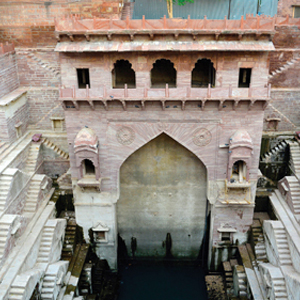
[Left] Toor Ji Ka Jhalra, a stepwell in Jodhpur, is 60 feet deep and has 400 flights of stairs. (Photo: @Facebook/SteveOnShow)
For most of us today, the luxury of running tap water is so ubiquitous that we rarely give it a second thought. Clean, cool water flows reliably from every faucet, twenty-four hours a day, supporting every aspect of daily life—from showering and boiling tea to watering plants and doing laundry. This uninterrupted convenience is a modern marvel we tend to take for granted.
 Today’s generation, in particular, has little inkling— let alone appreciation—of a time and place when water was not just a utility, but a precious and a fiercely-protected commodity, dictating the rhythms of existence and the shape of communities. Water had to be collected in rudimentary spaces, conserved, and carried back home to be used judiciously.
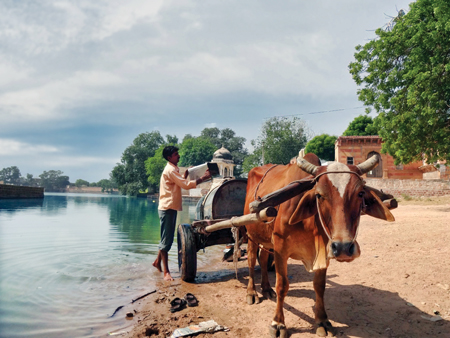
[Right] A man filling up a small tank for domestic supply from Lakholaav pond in Marwar Mundwa town of Nagaur district.
A scarcity of something makes it special. That’s one reason why the state of Rajasthan has historically sanctified water conservation, perhaps more than any other place in India. Low rainfall and saline 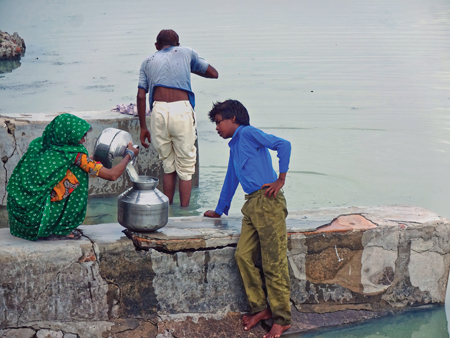 groundwater have turned its people into exceptional conservers, building not only beautiful and durable structures, but also developing sustainable practices around them. Ponds, lakes, stepwells, dug wells, irrigation channels, and underground tanks showcase the resilience of human ingenuity and a spirit of collaboration.
While some water-harvesting structures were funded by kings, queens, and traders, most came into being through the collective contribution of labor, money, and materials by common people. Over time, these vital infrastructures became nests of biodiversity, linking trees, wildlife, and humans.
[Left] Locals collecting water from a pond in a village near Nagaur.
Rajasthan’s heritage of water wisdom endures— each structure a story of collective effort and adaptation, proving that even in scarcity, communities can thrive through ingenuity and shared stewardship.
PONDS: Symbols of Community Effort
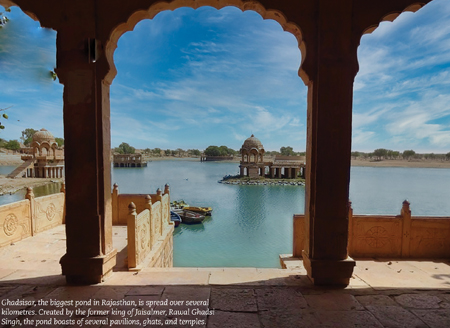
 Rajasthan has worked hard to earn its reputation as the state of ponds and lakes. The largest, Ghadsisar, is renowned for the many temples, domes, and pavilions that surround it. Crafted in Jaisalmer’s signature yellow stone and adorned with ornate carvings, it was initiated in 1367 by Raja Ghadsi Singh Bhati. It benefited from the patronage of the wealthy and celebrated figures of the time, including a dancer who funded new ghats, temples, and rooms for travelers.
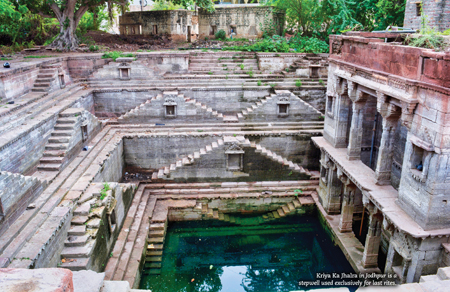
[Right] Kriya Ka Jhalra in Jodhpur is a stepwell used exclusively for last rites.
Overflow from Ghadsisar filled nine other sequential ponds, transforming India’s driest town into a water-surplus settlement and sustaining the entire community. Today, Ghadsisar has become a tourist lake, complete with boating and recreation.
Village ponds remain vital for locals. At Lakholaav Pond in Marwar Mundwa town of Nagaur district, brackish groundwater makes the pond the primary source of drinking water throughout the year. Both residents and the municipal committee work diligently to maintain cleanliness and manage the catchment. Women draw water throughout the day, while ox-driven tankers deliver to homes for a small fee.
The city of Udaipur is famed for its seven inter-connected lakes. The overflow from one lake fills the next, forming a notable example of rainwater harvesting and management.
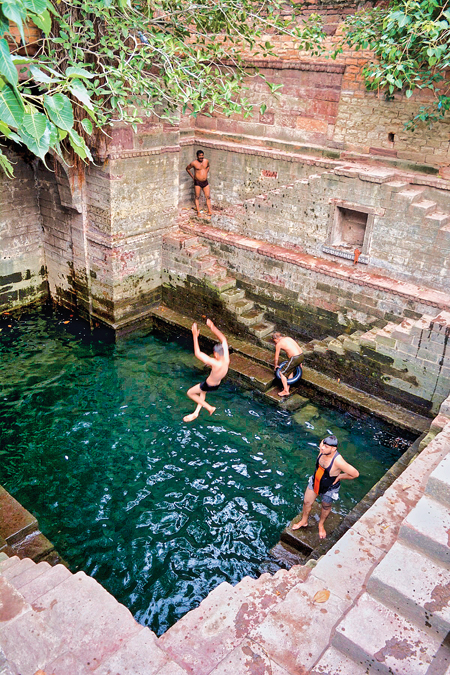
[Left] Young men diving into waters of Taapi stepwell in Jodhpur city.
STEPWELLS: Life Saving Marvels of Architecture
Beyond serving as water reservoirs, the stepwell (baori) traditionally functioned as a recreational and cooling retreat. Graced with intricate design formations of the steps, these stepwells, carved below ground, are now major tourist attractions. Jodhpur alone boasts more than a hundred stepwells, many of which are hidden in its labyrinthine alleys. Several remain in use, with water drawn using electric pumps. In recent years, a movement to clean and restore stepwells has drawn support from volunteers and the city’s erstwhile royal family.
TAANKAS: Traditional Rain-Harvesting
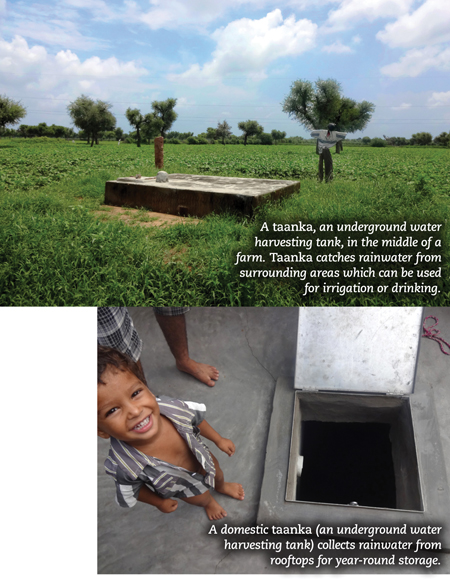
A taanka—also called a kund or kundi—is Rajasthan’s simplest and most prevalent water structure. Its size varies by geography and purpose, ranging from collecting rainwater to acting as an underground storage tank. While ponds and stepwells serve many, the taanka is small, lined with lime to prevent seepage and typically covered to reduce evaporation. It may stand by a roadside for travelers or be built in a home for domestic use.
 Despite the spread of piped water, taankas endure. Traditionally, household taankas were connected to a portion of the courtyard that was kept especially clean to collect water; now, water from the rooftops is directed into them, implementing rooftop rainwater harvesting—often without government aid or specialist input.
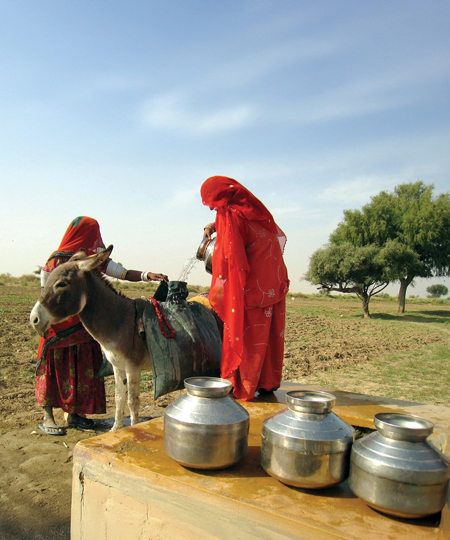
[Left] Women drawing water from a shallow well (beri) near Ramgarh town in Jaisalmer.
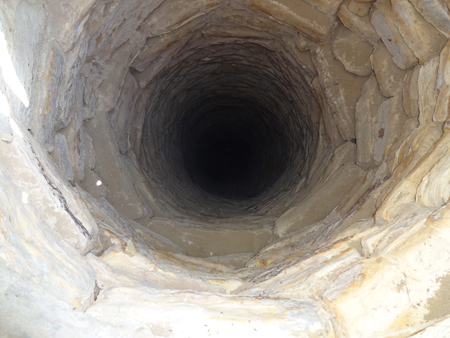
[Right] A traditional well with stone masonry in the Thar desert.
BERIS: Streams of Water Underground
Although groundwater in much of West Rajasthan is brackish and unsuitable for drinking, specific regions possess unique geology that traps rainwater within layers of sand, gravel, or clay, shielding it from mixing with saline water. This vital knowledge is passed down through generations, enabling people to dig shallow wells, or beris, to access sweet water.
Even in lean monsoon years, these reserves refill, remaining safe from evaporation due to their subterranean protection. Digging beris is arduous; the walls require reinforcement every few feet to prevent collapse. Traditionally constructed with stones, lime, timber, or grass rope, cement is often used these days for ease and stability.
DEEP WELLS: Camel-Fetched Water
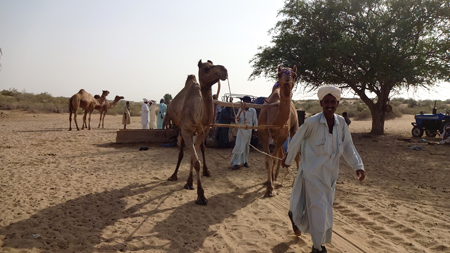
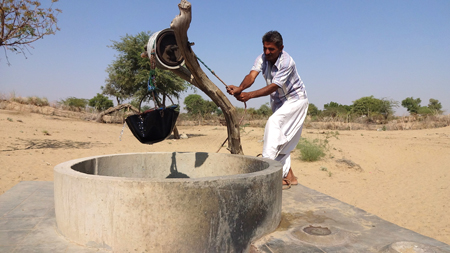
Deep wells are rare in the Thar Desert, but where they exist, they are often the only source of potable water in the absence of taps or ponds. Some go as deep as 250 feet. To draw water, a chadas (leather bucket) is thrown into the well, then ropes tied to camels' backs are used to raise it. The camels walk about 50 meters, hauling the full chadas to the surface. The water is then poured into large leather bags and distributed by mules to nearby settlements, or dhaanis. Mechanical pumping isn’t practical here: it could exhaust the source. Camels, then, remain a lifeline in Rajasthan’s struggle against drought.
Manu Moudgil is an award-winning journalist and researcher with over 20 years of experience in environment, agriculture, science, and social justice. He has traveled extensively and reported from 13 of the 15 major agro-climatic zones in India, besides conducting training workshops for journalists, media students, and social activists on the climate crisis.
Enjoyed reading Khabar magazine? Subscribe to Khabar and get a full digital copy of this Indian-American community magazine.