


Point of View: One State Is Key to Understanding the Resistance

Home to about 20% of Indian Americans, California—the most populous, richest, and perhaps the most innovative state in the union—is the biggest target of Trump 2.0’s anti-immigrant and anti-democratic agenda. The bellwether state has been fighting back, but can we still say, ‘As California goes, so goes the nation’?
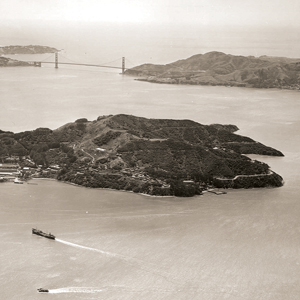
[Left] Angel Island in San Francisco Bay
Maganlall K. Pandit, not unlike the approximately 2.5 million South Asians who fought in World War II, is forgotten today. It’s worth remembering him, eight decades after the Allied victory, because this U.S. sergeant—a migrant from British India—had also served in World War I as a private. Like other Indians in the early years of the 20th century, Pandit must have come to the U.S. via the West Coast. Bhagat Singh Thind, another World War I veteran, certainly did.
In California, Thind joined the Ghadar Party, which agitated for the overthrow of British rule in India. While Thind is mainly remembered for his battle over U.S. citizenship, he was also, along with many other immigrants of that period, a freedom fighter for India in his younger years. And like Dalip Singh Saund, who famously became the first Asian American and Sikh to win a seat in the U.S. House of Representatives, he earned his PhD from the University of California, Berkeley.
When we think of immigrants coming to the U.S., it’s the Statue of Liberty that looms large in our imagination. Also in New York Harbor is Ellis Island, which had been a celebrated entry point for European immigrants. However, on the other coast, Angel Island in San Francisco Bay has a darker history. This gateway for Asian migrants, which operated for just three decades, had a higher rejection rate and the detainees faced harsher sentences. Race played a role, but so did the anticolonial fervor and activism of travelers who washed up here. Between 1910 and 1940, only an estimated 8,000 migrants from British India were allowed to enter the U.S. via Angel Island.
California has a long history of political activism, which is not limited to the Bay Area, where Kamala Harris’s parents took part in the civil rights marches of the 1960s. In the Imperial Valley, where many Indian migrants cultivated land, there was agitation for the rights of farmworkers. Then there is Southern California, a progressive stronghold that’s known for Hollywood, whose movies have shaped how the rest of the world views America.
It was a southern Californian, arguably, who became the most prominent Indian-born World War II veteran. That was Sabu Dastagir, better known as Sabu, the first Indian to gain movie stardom in the West. Sabu, who died in 1963 at the age of 39, flew dozens of missions in the Pacific War with the 370th Bombardment Squadron, even winning the Distinguished Flying Cross for his valor and achievement.
Coming to the current moment, there’s little doubt why California—with Los Angeles as the epicenter—is Trump 2.0’s biggest target. With its 54 electoral votes, the highest among all states, California has become so thoroughly Democratic that George H.W. Bush was the last Republican presidential nominee to win the Golden State. That was back in 1988.
“Many forces have propelled that shift, of course, but chief among them are the parties’ divergent approaches to the environment and immigration and the shifting demographics of California, which, like so many things emanating from this state, are just now beginning to wash over the rest of the country as well,” writes Jim Newton in Politico.
“As California goes, so goes the nation,” it’s been often said.
This infuriates the GOP, for whom California is too “liberal” and “woke” but also too powerful to ignore. The country’s most agriculturally productive state is also technologically advanced, with Silicon Valley being the ultimate mecca for innovators. And it is the wealthiest state. Only three nations in the world have a higher GDP, with India being right behind California for now.
Does California have problems? Yes, of course. The housing crisis and high cost of living have driven many people out of the state, and some would argue that there is excessive regulation. But few states are more committed to tackling climate change, and California has the country’s strictest gun regulations. Red states have some of the loosest gun laws. Diversity is dangerous, apparently, but not firearms. Conservatives are interested in maintaining the status quo—except, ironically, when it comes to the environment. For Blue states, diversity is not scary.
The Golden State embraces pluralism and is future-oriented, attracting droves of young people who are comfortable with change. And no other state has a larger share of immigrants. About a fifth of the total immigrant population (22%) lives in California, according to the Public Policy Institute of America (PPIC), and 45% of children in the state have at least one immigrant parent. Interestingly, 90% of the state’s immigrants are from two regions: Latin America and Asia.
Almost half (49%) of California’s immigrants are from Latin America, but contrary to popular belief, the Asian share of the immigrant population (41%) is growing faster. As Pew notes, about 20% of the Indian American population lives in California. The next state, Texas, which is gaining residents unlike California, has under 12% of the Indian American population. Between 2013 and 2023, California’s Indian American population grew by 50%.
 Of the six Indian Americans currently serving in the U.S. House, two representatives—Ro Khanna and Ami Bera—are from California. Khanna’s congressional district includes the dynamic and prosperous Silicon Valley, where two-thirds of the workers were born abroad. Kamala Harris, who has served in the U.S. Senate, is also from California. A report from last year shows that immigrants founded 45% of tech startups in the Bay Area.
Unsurprisingly, Trump—who lost California by huge margins in the 2024 election (3.2 million votes) and the 2020 election (5.1 million votes)—takes his defeat in the Golden State personally. He is determined to bring it to heel and, presumably, set an example for the entire nation.
But it may not be that easy, as we’ve seen from the vigorous opposition. Gavin Newsom, the governor of California, has said they would Trump-proof the state. The president has a lot of power, but the power of states is not inconsiderable, and no state is more powerful than California, which contributes more to the federal government than it receives. In 2022, for instance, California’s net contribution was around $83 billion more than what it got.
In the tense clash between Trump 2.0 and California, no issue is more important—and emotionally charged—than immigration. California Senator Alex Padilla, who was handcuffed during a contentious press conference with Homeland Security Secretary Kristi Noem, summed it up perfectly: “Diversity and migrants doing well and making our country stronger is Donald Trump’s worst nightmare—and that has made California his number one target.”
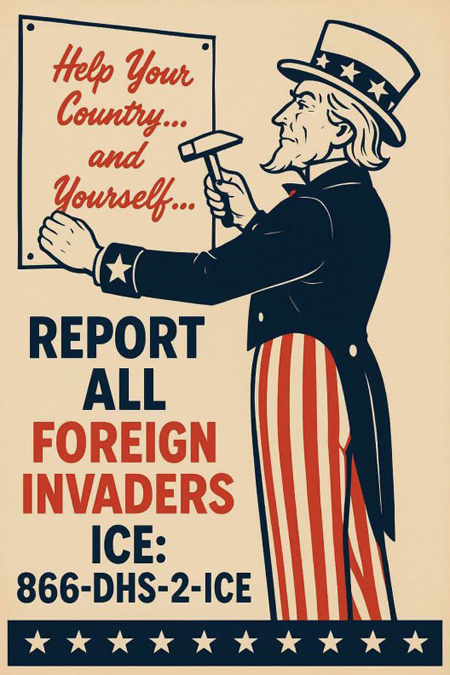
[Right] World War II-style poster from Homeland Security
This summer, 700 active-duty Marines, along with hundreds of soldiers from the California National Guard, were deployed to quell protests in Los Angeles. It was an extraordinary show of force against largely peaceful, unarmed civilians. The governor and mayor were outraged. The last time a president called on the National Guard without a state governor’s consent was in Alabama during the civil rights protests of 1965.
Some have called Trump’s actions political theater. But though it’s true that Trump—like no other president—is enamored by television and theatrics, it would be a mistake to downplay the seriousness of his administration’s crackdown on immigrants. The so-called Big Beautiful Bill, which has been signed into law, allocates roughly $170 billion for immigration and border control, greatly enhancing the capabilities of ICE (Immigration and Customs Enforcement). The impact will be felt in immigrant communities throughout the nation.
Three decades ago, when California targeted migrants after it passed a ballot initiative called Prop. 187, there was a backlash, especially from the Latin American community, and Republicans ended up being the losers. Democrats now hold a veto-proof supermajority in both houses of the California State Legislature. As Jim Newton points out in his Politico article, Prop. 187 “turned out to be the high-water mark for anti-immigration enthusiasm in the state.”
And now, as we contend with Trump 2.0’s turbocharged anti-immigrant policies, will there be a large enough backlash in the rest of the nation—and will other states follow California’s lead?
Murali Kamma is the managing editor of Khabar. A slightly different version of this article appeared in The Quint, a news and opinion media outlet based in New Delhi, India. Please send your comments to letters@khabar.com
Enjoyed reading Khabar magazine? Subscribe to Khabar and get a full digital copy of this Indian-American community magazine.