

Travel: Ladies Only Adventure in South Africa

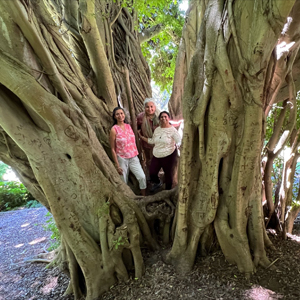
[Left] Strangling fig tree at Kirstenbosch Garden
Some trips originate from bucket lists, while others happen more spontaneously. This one came about because of a chance encounter in India with a man whose Indian ancestors had immigrated to South Africa generations ago. Guided by his tips, the adventurous two-week journey took the travelers from Cape Town to Kruger National Park and back again via the spectacular 190-mile Garden Route.
 November is a gorgeous season to visit the southern hemisphere when the summer is just beginning to lengthen the days. After a long journey, we reached our Airbnb located in the Sea Point neighborhood of Cape Town. After a shower, nap, and snack, we took the pedestrian path along the ocean to the Victoria and Albert (V&A) waterfront, a happening place with restaurants and live music on a Friday evening.
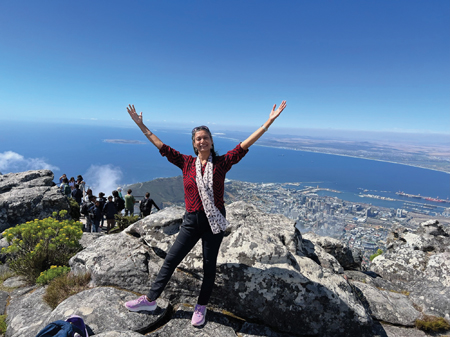
[Right] The author on Table Top Mountain
With a plethora of choices for outings the next day, we chose to visit Kirstenbosch National Botanical Gardens, which spreads over 100 acres and has showcased both the history and diversity of indigenous flora for over 100 years. While studying the map and wondering where to begin, we met 81-year-old Howard Hamilton, a genial gentleman who offered to share his knowledge of the gardens with us. He walked slowly with a cane and a small bag which contained photographs of various attractions.
We matched his pace and made our way through the Enchanted Garden, past Pearson’s Grave, and by Colonel Bird’s Bath. He pointed out the most common foliage: fynbos (fine bush in Afrikaner), the cycads, and King Protea (national flower). At his recommendation, we climbed an ancient almond tree and into the trunk of a giant strangling fig tree for touristy photo-ops. Spending time in nature is the best way to ground yourself and connect to where you are. It wasn’t surprising that we were able to overcome our jet lag after a day spent outdoors and the good night’s sleep that followed.
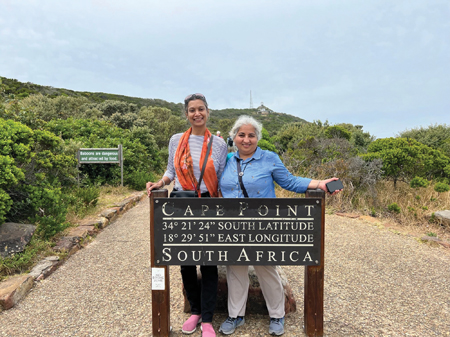
[Left] Cape Point
 If you have seen any tourist brochures of South Africa, chances are that you come across at least one picture featuring a person perched precariously at a high altitude with arms raised and a beautiful bay with a clear ocean in the background. That spot lies on the top of Table Mountain, Cape Town’s best-known landmark. As the name suggests, it is a high mountain (1,067 meters) with a flat top that is three kilometers in length. While it is possible to hike up to the top, we chose the easy route and took a five-minute ride on the cable car that rotates as it ascends and provides a view of both the mountain and the ocean that forms the backdrop of Cape Town.
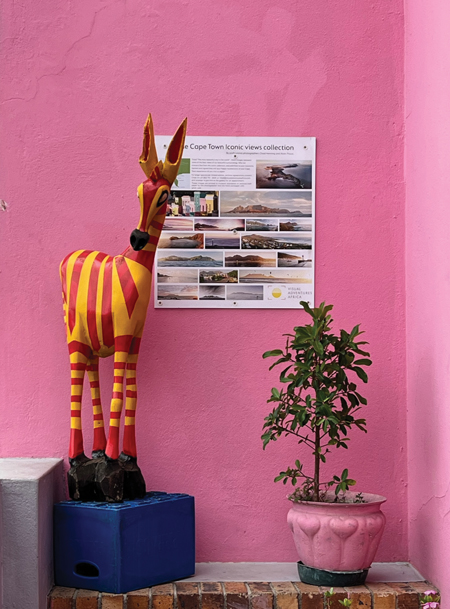
[Right] Bo-Kaap in Cape Town
The notorious fog (aka ‘tablecloth’) descends without warning and we changed our booking from the morning to the afternoon based on the ever-changing weather forecast to ensure we had a good view during our time at the top. The clouds—sometimes wispy like baby hair, sometimes dense like a thick blanket—swooped up and down, above the summit and often below, obscuring the view completely in a matter of minutes. We visited the Bo-Kaap neighborhood with its quirky architecture and picked up souvenirs at Green Market while we waited for the fog to disperse.
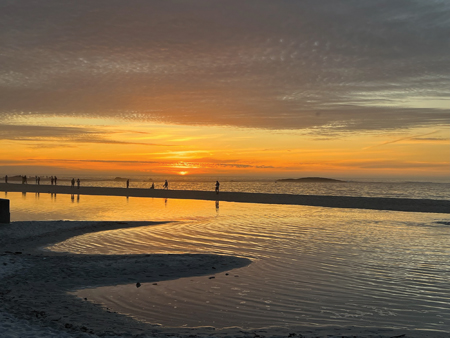
[Top] Camps Bay sunset
Sitting in silence watching the changing interplay of light and shadows as the sun repeatedly hid and revealed itself through the frolicking clouds, I thought about the capriciousness of life, the spectacular rare moments that brighten our days and the disappointments and failures that often plague us for much longer. Yet everything is fleeting, nothing lasts forever, not even our own interpretation of life itself.
Seizing the lesson from that moment, I stood at the edge, arms wide open, facing the expanse of blue sky and passing clouds, trying to encapsulate the spirit of adventure and excitement that travel always ignites in me. A photographic image of a fleeting moment.
 The next day, we booked Rajel, the Uber driver who had dropped us at Kirstenboscho, to take us on a day trip to visit the surrounding attractions. Our first stop was Cape Point, situated within the Cape of Good Hope. This was where, I learned as a child, intrepid travelers turned eastwards to explore vistas leading to faraway lands. And now, here I was, riding a funicular—the Flying Dutchman—before climbing a flight of steps to the lighthouse. From here we could observe the merging of the Atlantic Ocean and the Indian Ocean, which has warmer currents. In the distance, the froth on the waves marked the location of breaching whales. The clouds floated in and out as we took another iconic picture that showed the latitude and longitude of Cape Point.
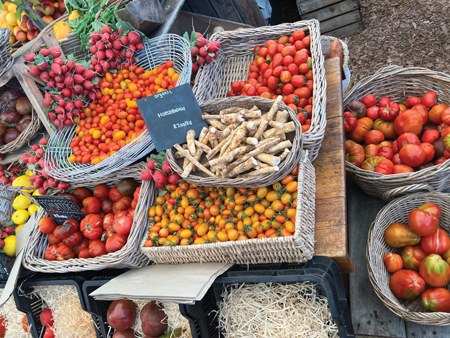
[Left] Fresh produce at Oranjezicht market
 Before reaching Simon’s Beach, our next stop, we found two surprising jaywalkers in our path. First, a group of baboons, mother-child pairs and several single ones, eating proteus flowers, staring at cars or ignoring them as they made their way across. A few meters later we came across ostriches, two majestic ones surrounded by a few chicks, going about their everyday lives. Certainly not a sight you see every day!
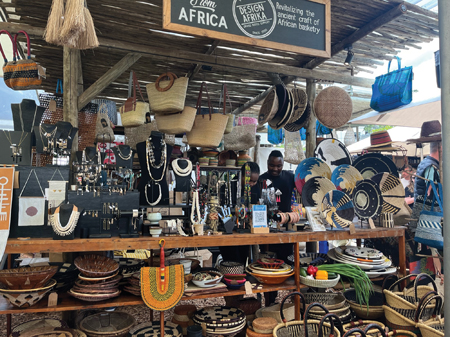
[Right] Handicrafts at Oranjezicht
The main attraction at Simon’s Beach are the small African penguins that you can observe from a manmade boardwalk for a fairly steep entry fee. The penguins were cute, waddling around alone or in groups, taking a leisurely stroll and stepping into the turquoise waters of a rocky beach. I was reminded of Juan Salvadore, the star of The Penguin Lessons, a poignant memoir by Tom Michell that I had recently finished reading.
We returned through the scenic Chapman’s Peak Drive, which has craggy mountains on one side and a beautiful curving road with a view of the ocean on the other. The grand finale of a perfect day was the spectacular sunset at Camps Bay. The Atlantic Ocean felt warm on my feet as I walked along, observing keen photographers setting up to capture the interplay of light and color as the sun displaying alternating light and dark bands dipped slowly into the horizon. On our last day in Cape Town, we spent the morning at Oranjezicht market where local produce, fresh food stalls, artisanal bread, jams, and soap stalls shared space with South African handicrafts. The vibe of the market was contagious and we sat there all morning sipping coffee and tasting new flavors before heading out for our flight to Kruger.
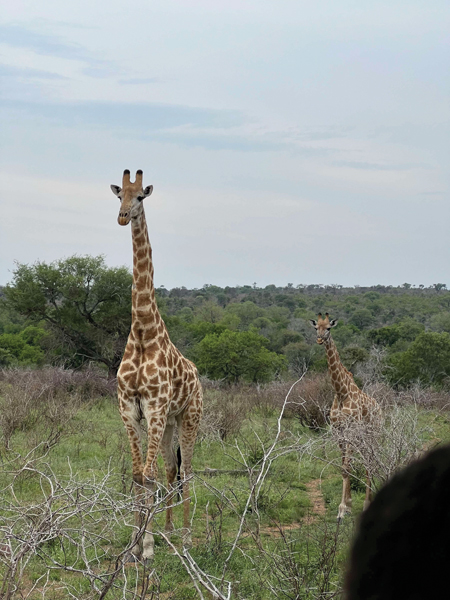
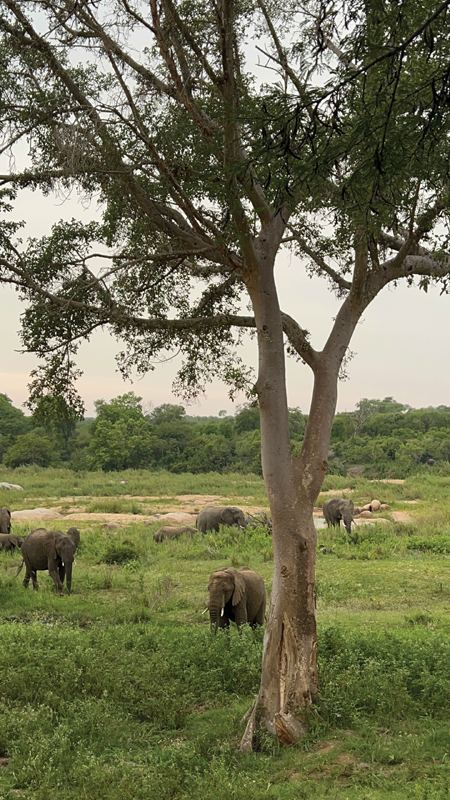 The big five game that one is supposed to spot while on a safari in Africa include the lion, leopard, elephant, rhinoceros, and the African buffalo. On my visit to the Serengeti in 2019, I had seen four of them. The rhino, however, had been shy and elusive.
As we checked into Kruger Gate Hotel, we were offered a chance to sign up for the evening safari, which provides a good chance of spotting all the significant wildlife that the region is famous for. Valli, the driver cum guide of our 20-seater open jeep, raced through a park, as if on a mission to show us as much of the 20,000 square kilometers of the park as possible before dark. We spotted several giraffes, impala, zebras, elephants, 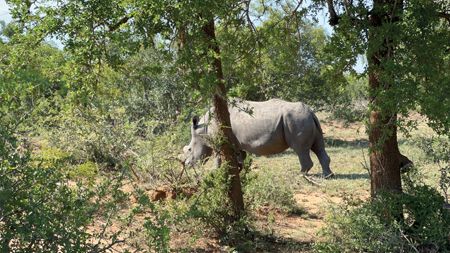 and hyenas—but no rhinos.
[Left] Giraffes, elephants, and a rhino at Kruger
My disappointment was soon forgotten thanks to the sumptuous dinner at the Lapa Restaurant, which offered a big spread of local cuisine, including vegetarian African options like pap (white corn patties) with sheba and shakalaka, tomato-based gravy dishes.
On a dawn safari the next morning, we were fortunate to appreciate all of the big five animals, including two large two-horned rhinos and a cute baby one that were chilling by a water body. One rhino suddenly decided to cross the road just ahead of our vehicle. The horns were cut off to deter poachers, which seemed a sad but necessary step to prevent them from going extinct. As we moved through the park, several groups of animals—including giraffes, zebras, deer, and warthogs—could be seen going about their everyday lives. Lions and leopards were fewer in number and stayed out of view, but we were able to spot them. The happiest were the hippos, lazing around in a large water body, oblivious to the exclamations and clicks of tourists.
That evening we chose to lounge by the observation deck at the hotel at sunset. The deck with a small pool overlooking the river was a good location to view wildlife in the dry season. But the water level wasn’t high in the riverbed. As night descended, a large herd of elephants showed up, first in ones and twos, and thirty minutes later, there were almost fifty or more elephants, grazing, drinking water, looking for the marula trees which produce sweet fruit with an intoxicating flavor that elephants particularly crave. It was a fitting end to a safari, and we left for Johannesburg via the Panorama Route the next morning, eager for the next chapter of our adventure.
Ranjani Rao is the author of Rewriting My Happily Ever After: A Memoir of Divorce and Discovery and The Coherent Writer newsletter. Email: letters@khabar.com
Enjoyed reading Khabar magazine? Subscribe to Khabar and get a full digital copy of this Indian-American community magazine.