

Travel: Pagodas, Palaces, and the Wonder That Is Angkor Wat—All on a River Cruise

Trading holiday gifts for soul-stirring journeys, the author and her husband travel down the storied Mekong River through Vietnam and Cambodia—stopping everywhere from vibrant Saigon to mystical Angkor Wat—and along the way, discovering ancient temples, street feasts, and echoes of shared Asian heritage.
 All PHOTOS, courtesy of the author
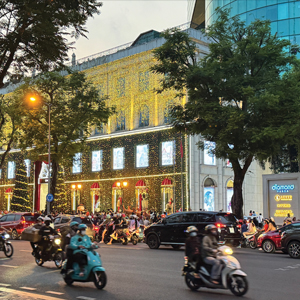
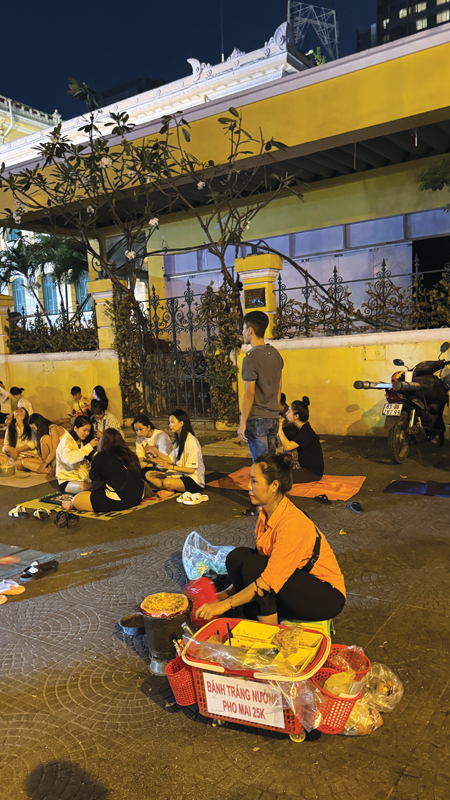
Saigon reminded the author of Connaught Place in New Delhi, thanks to its upscale shopping malls decked out with Christmas lights, juxtaposed with rows of street vendors selling freshly prepared food.
Every holiday season, my husband and I prefer to gift ourselves a memorable adventure instead of material presents. Last year, we escaped Atlanta’s winter freeze and flew to warm and tropical Vietnam in December. We booked a seven-night river cruise on the Mekong River, which flows through six countries, including Vietnam and Cambodia—the two nations covered in our cruise. Our promising all-inclusive journey would take us to hard-toreach areas along the river in comfort while also allowing us to explore some of the bigger cities along the way.
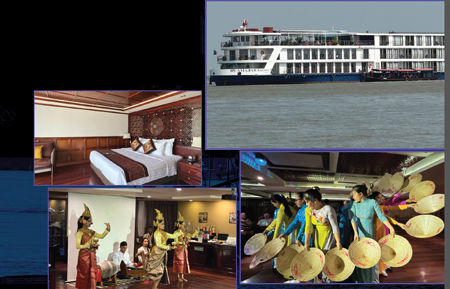
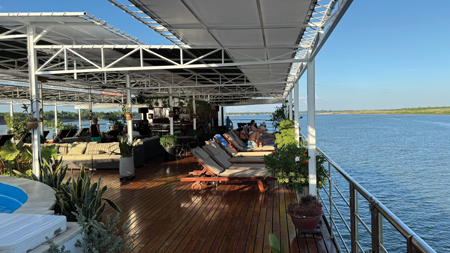
“This was unlike any other cruise ship I had been on—tiny compared to ocean liners, with handcarved wood adorning all three decks.” Scenes from the cruise ship.
Delhi Vibes and “Dhol Baaje” in Ho Chi Minh City
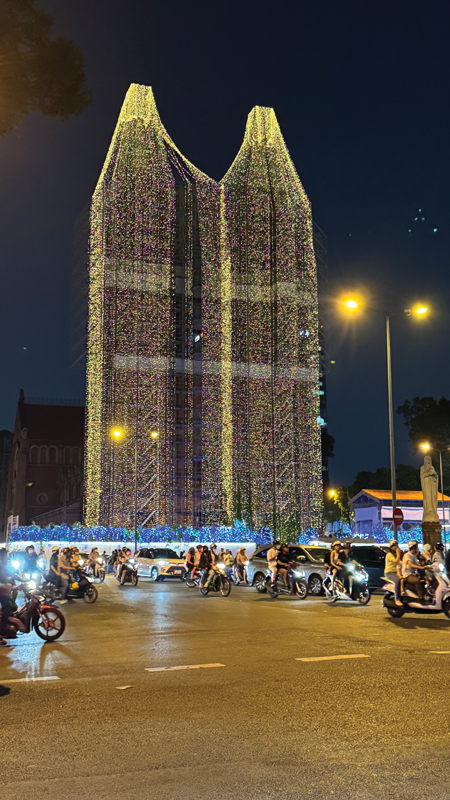
We started in chaotic yet charming Ho Chi Minh City (Saigon). Its broad, tree-lined streets, filled with motorcyclists, reminded me of Connaught Place in New Delhi. Upscale shopping malls were decked out with Christmas lights and decorations, juxtaposed with rows of street vendors selling freshly prepared food, fake designer handbags, and discounted clothing.
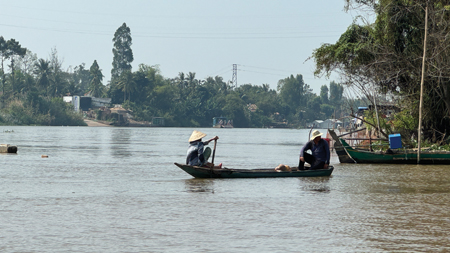
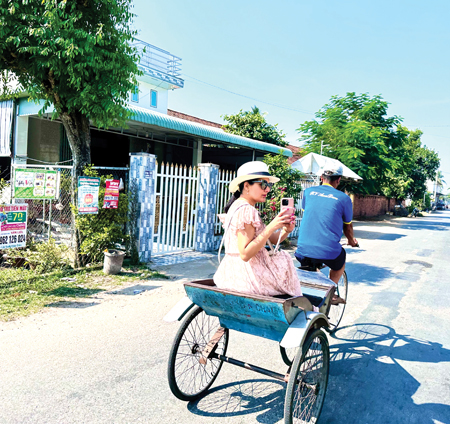 [Right] The AmaDara cruise provides a wonderful close-up of river life through Vietnam and Cambodia through land excursions by foot, boat, tuk-tuk, bus, or cycle rickshaws.
 On an open-air stage, a Vietnamese street performer danced to the tunes of “dhol baaje,” which felt rather odd given the place and the audience. Most locals sat directly on the pavement (or footpath, as we say in India), enjoying hot noodle soups, rice vermicelli, and crispy savory pancakes.
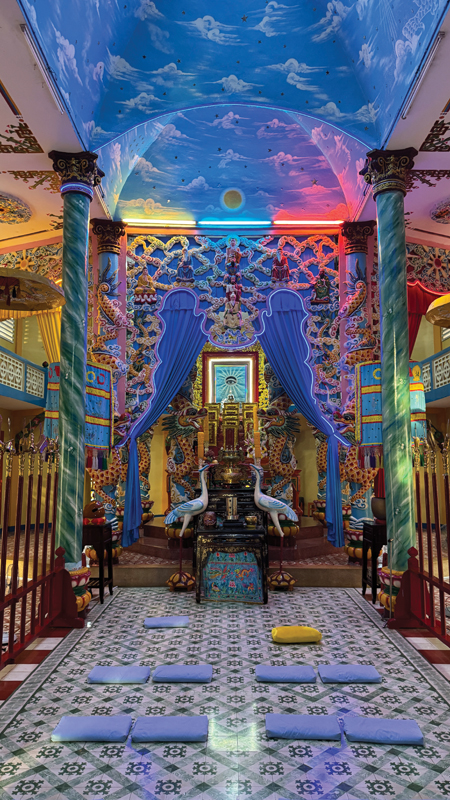
[Left] The stunning interior of Cao Dai Temple. Caodaism, which originated in Vietnam in 1926, is a syncretic mix of Buddhism, Christianity, Islam, Hinduism, and Confucianism.
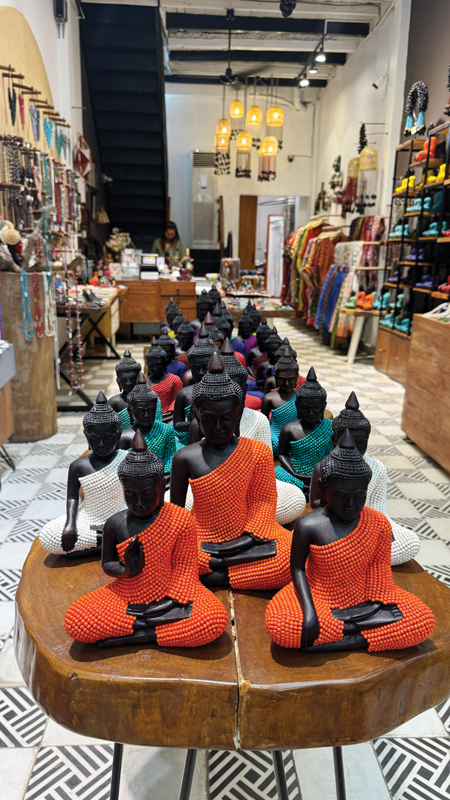 [Right] Buddhas, small and large, everywhere: some that you can take home with you, and others that you admire as tourists.
For our first dinner in Vietnam, we opted for a fancy sit-down restaurant called Nha Hang Ngon, where we relished fried chili shrimp, stir-fried Chinese cabbage, fried rice, and a vegetarian clay pot.
After a good night’s rest at the luxurious Sofitel Saigon Plaza, we were transported by bus to My Tho Port, where we boarded AmaDara, our river cruise ship, and met up with the other 50 or so passengers. This was unlike any other cruise ship I had been on—tiny compared to ocean 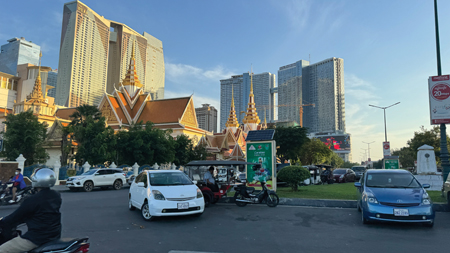 liners, with hand-carved wood adorning all three decks. The spacious cabins came with balconies, and the rich fabrics, live tropical plants, and paintings depicting life along the Mekong were subtle, elegant reminders of the region.
[Left] The fascinating juxtaposition of ancient temples and modern skyscrapers in Phnom Penh, the French-influenced capital of Cambodia.
The staff hailed mainly from Vietnam, exhibiting cultural attire and traditions I could relate to— folded hands in greeting, bows of respect, and warm Asian hospitality. Even the food served on board was inspired by our location: fresh dim sum, peanut-dressed salads, clear noodle broths, vegetable stir-fry, and
 creamy korma—all paired with French wines. For breakfast, there was always a spread of tropical seasonal fruits—mango, guava, rambutan, and durian—which non-Asian passengers found fascinating while I indulged myself.
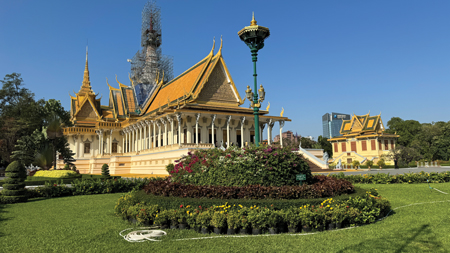
[Right] The Royal Palace in Phnom Penh, Cambodia.
Of course, the main reason to visit this area was to see the historic pagodas and temples, the colorful markets, and the living cultural traditions.
Vietnam Countryside: Market Streets, Temples, and Silk Dreams
We generally had one or two land excursions each day, traveling by foot, boat, tuk-tuk, or bus. At Cai Be, we disembarked by small fishing boats to visit a workshop where locals made traditional popped rice candy (similar to muri) and rice paper. We journeyed to Sa Dec, walking through busy fish and vegetable markets in the sprawling town where French writer Marguerite Duras spent part of her youth. At Cao Dai Temple, I learned about the unique religion of Caodaism, which originated in Vietnam in 1926—a syncretic mix of Buddhism, Christianity, Islam, Hinduism, and Confucianism. How practical!
In the small town of Tan Chau, we each got on our own traditional xeloi, a motorized rickshaw, to travel parallel to the river and watch the town’s daily activities unfold. The silk and rattan mat factory was one of my favorites, as we watched how Vietnam’s prized silk fabrics were handwoven, naturally dyed, and made into traditional garments (resembling kurta-pajama), blouses, and scarves—sold at very affordable prices.
[Left] The spectacular Silver Pagoda in the Royal Palace complex.
 Phnom Penh: Skyscrapers, Gold Temples, Upscale Restaurants—And the Grim Killing Fields
From Vietnam, we crossed the border into Cambodia to the French-influenced capital of Phnom Penh. The ship docked right in the midst of the city, from where we could see skyscrapers and flaming gold temples. Foreign investments had made Phnom Penh one of the fastest-growing cities in Asia. There was construction everywhere, and advertisements for new luxury condos for sale were juxtaposed with exposed electric wires and monks in orange robes. Finding the city easy to navigate and quite safe, we ventured out on our own to try various Indian and upscale Cambodian restaurants that delivered some of the best food and service of the trip.
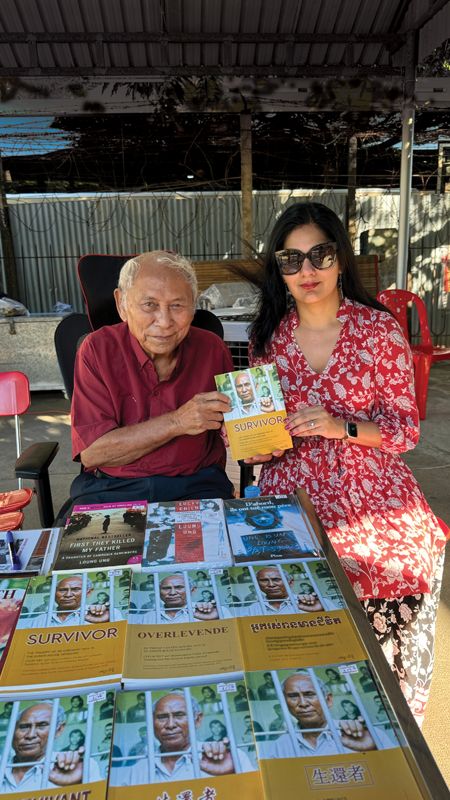
[Right] The author, with one of the only two survivors of the 20,000 prisoners who perished in the Cambodian genocide, at the infamous Killing Fields, a mass grave and memorial for the victims.
I was particularly impressed with the ornate design of the Royal Palace complex—the official royal residence of the King of Cambodia—as well as the spectacular Silver Pagoda and the collection of Khmer crafts at the National Museum. We then shopped for silk table runners and mother-of-pearl bowls, drank Angkor beer, and challenged each other to try fried grasshoppers and tarantulas tossed in MSG, sugar, salt, and crushed garlic (a local delicacy) at the bustling, yellow-colored Central Market.
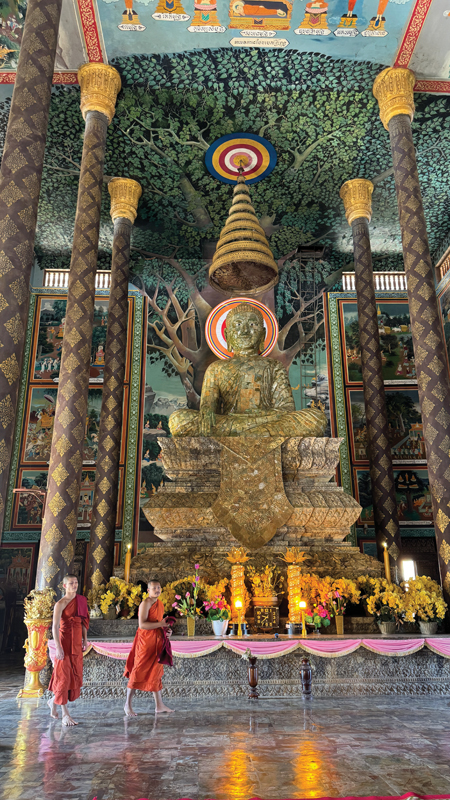
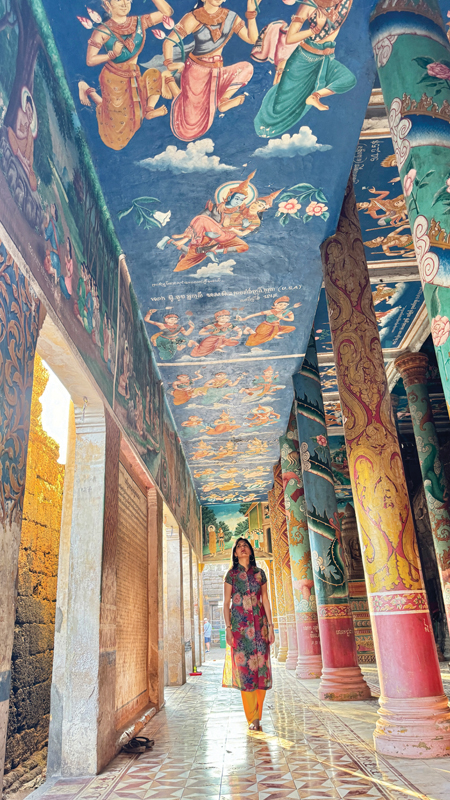 A grim yet sobering excursion took us to Cambodia’s infamous Killing Fields, a mass grave and memorial, and the Tuol Sleng S-21 detention center (Genocide Museum). We visited the ruins of a secondary school that had been turned into a torture center and prison from 1976 to 1979. Tuol Sleng, known as Security Prison 21, was one of between 150 and 196 torture and execution centers established by the Khmer Rouge. Only two of the 20,000 prisoners who ever came to S-21 survived, and we were fortunate to meet both of them in person, signing their autobiographies at the museum entrance.
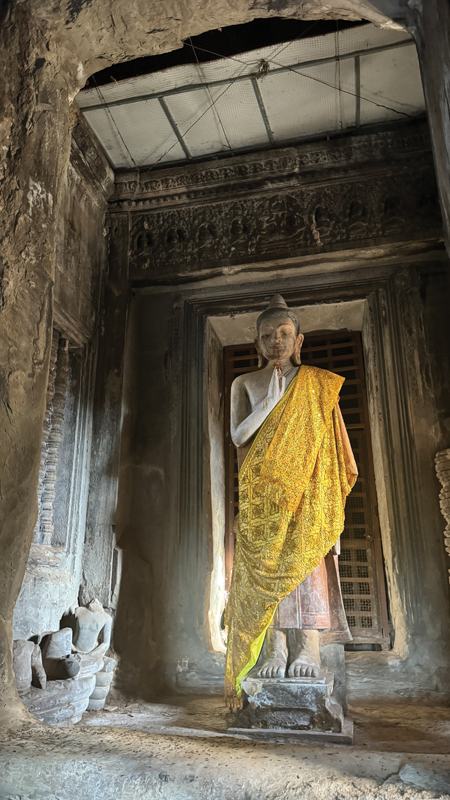
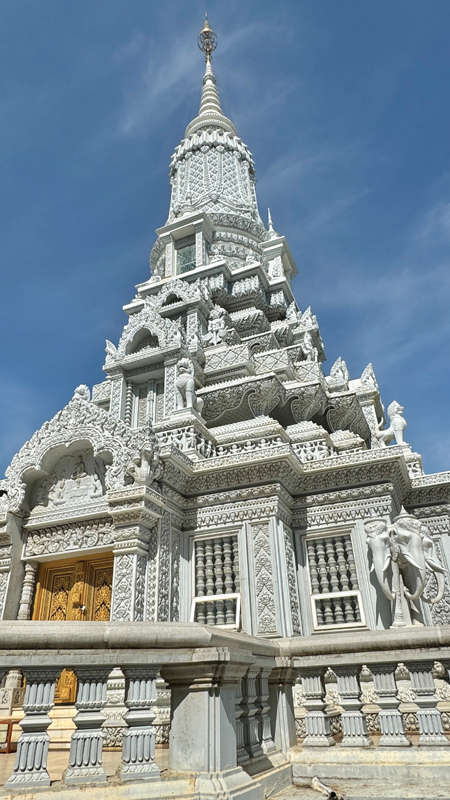
[Left] The majestic interiors of Cambodia’s temples beautifully blend Buddhist and Hindu cosmological themes.
I had known very little about this piece of history until our guide shared stories of how his own family and neighbors were murdered for their intellect and independent thinking. The Cambodian genocide wiped out almost two million people—a quarter of the country—and the pain remains fresh in many citizens’ memories.
Buddhist Blessings and Riverside Lives
Nearby, we visited Oudong, a pilgrimage site and Cambodia’s former royal capital. It was very hot and humid, but climbing up to the hilltop pagoda to see panoramic views of the largest monastery in Cambodia, surrounded by the Oudong plain, was well worth it. Afterwards, the Buddhist monks at the monastery recited chants and blessed us for a safe onward journey.
We passed by countless rice paddies, fish farms, and silt factories while sailing along the Mekong. The river was still a lifeline for millions and sometimes the only means of travel. It narrowed in several places, forming islands that housed entire villages. Here, people lived in traditional wooden abodes shaded by banana trees, keeping their cultural traditions alive.
Harbored by the channels, Angkor Ban was one of the few Cambodian settlements that managed to survive bombing raids, the Khmer Rouge, and severe flooding. As we walked along the dirt streets, we saw young monks in orange robes returning from school, passing statues of gods and goddesses dressed in traditional attire, and a giant resting Buddha statue. Even the cemetery looked like a series of miniature temples for gods and kings, with pointed spires and detailed gold engravings.
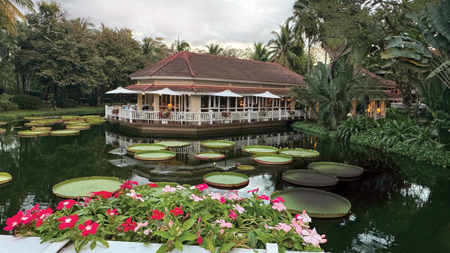
[Right] The dreamy tropical storybook setting of the Hotel Sofitel Siem Reap, with blooming lily pads.
Siem Reap: Where the Sacred Meets the Spectacular
Our final stop was the UNESCO-designated Apsara city of Siem Reap. Hotel Sofitel Siem Reap looked like a dreamy tropical storybook, with blooming lily pads, rattan lanterns dangling from the trees, and hundreds of fresh orchids in the lobby. The posh French Colonial–designed hotel also featured Cambodia’s first champagne bar and a restaurant buffet offering an endless spread of delicacies from across Southeast Asia—including my favorite, chicken biryani!
Walking around Siem Reap’s tree-lined streets felt peaceful, yet it was also a bustling tourist hub with artisan shops, cafés, bars, and restaurants. At night, Hanuman Pub Street was alive with merrymakers.
Filled with loud music, sports bars, and international eateries, the street was a magnet for younger travelers and backpackers. You could find anything here—from a hand-carved rosewood Buddha statue and locally designed Western dresses to a TUMI suitcase to pack it all in (I actually needed one). Tired from our shopping spree, we treated ourselves to $5 foot massages at a nearby spa.
There were countless ancient and historic sites to explore in Siem Reap. Dramatic root formations covered the 12th–13th-century Ta Prohm Temple, where Tomb Raider was filmed. The 10th-century Banteay Srei Temple, made of pink sandstone, was dedicated to the Hindu god Shiva. And the Bayon Temple, built in Khmer baroque architecture, served as the state temple of King Jayavarman VII.
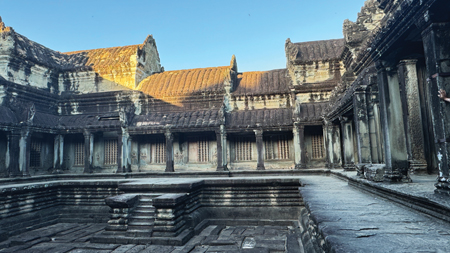 The granddaddy of them all, of course, was the world-famous Angkor Wat—the single largest religious complex in the world, designed in unique Angkorian architecture, and regarded as one of the world’s wonders. Constructed for the Khmer Empire by King Suryavarman II in the 12th century, Angkor Wat was originally a Hindu temple dedicated to Vishnu but was gradually transformed into a Buddhist temple later that century.
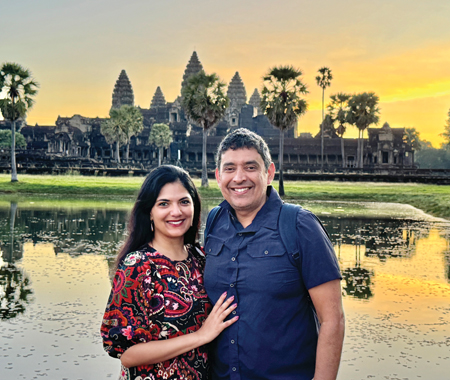 Angkor Wat, a UNESCO World Heritage Site. “It was simply magical—no photo could capture the feeling of actually being there,” writes the author.
The best times to see the temple were at sunrise and sunset. We woke at 4 a.m. and headed to the complex in the dark, watching Angkor Wat’s towering silhouettes emerge against the dramatic blue, orange, and gold hues of dawn. It was simply magical—no photo could capture the feeling of actually being there. We spent several hours wandering through the temple’s stone hallways, admiring painted ceilings, majestic courtyards, and intricate carvings. It was easy to spend an entire day at Angkor Wat alone.
Throughout our journey, we enjoyed cultural talks, history lessons, and live performances aboard AmaDara. Women called “apsara” dressed in lavish silk brocade skirts and pointed headdresses, representing graceful figures from Hindu mythology. They looked like delicate porcelain dolls as they moved in slow, synchronized gestures to classical music. Cambodian culture brimmed with Hindu symbolism, and one of the dances depicted Lord Hanuman’s love story with a mermaid.
As we flew out of the brand-new SAI airport—its atrium adorned with a gleaming golden temple—we felt overwhelmed by the splendor, history, and culture we had experienced in just a week. The mighty Mekong could carry you back in time and remind you how blessed we are to explore the world’s corners in the comfort of modern travel.
Sucheta Rawal is an award-winning food and travel writer who has traveled to over 120 countries across seven continents. Find her on social @SuchetaRawal.
Enjoyed reading Khabar magazine? Subscribe to Khabar and get a full digital copy of this Indian-American community magazine.