

Tribute: A Pioneer and Pillar of Atlanta’s Indian Community

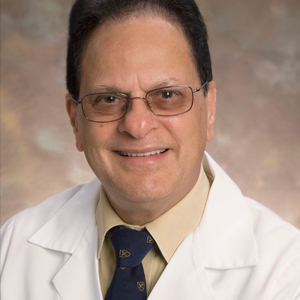
(January 29, 1938 – August 15, 2025).
Dr. BHAGIRATH MAJMUDAR left an indelible legacy in medicine, education, and Atlanta’s Indian and interfaith communities. A pioneering immigrant and founding member of IACA, he shaped its cultural life while serving as a devoted professor of pathology at Emory. To his students, he was more than a teacher—he was a mentor and father figure. Beyond academia, he was equally revered as a Hindu priest, Sanskrit scholar, writer, and guiding presence whose influence reached far beyond the classroom.
More than just a man of titles— professor, priest, poet, philosopher—“Bhagirathbhai” was a rare soul whose brilliance illuminated every corner of life he touched. I am just one of countless people who carry his imprint forever.
In 1990, I was visiting Atlanta for my final interview to join the faculty at Emory University. The department head, Brown Whittington, and the dean, Ron Frank, wanted me to meet Dr. Bhagirath Majmudar, knowing that connecting to the Indian community mattered deeply to my wife, Madhu, and me.
I will never forget that first meeting with Bhagirathbhai, which I credit for having had a major influence on my life and career. He struck me as someone who was simply brilliant. I would soon learn that he was nothing short of extraordinary in all his roles: advisor, teacher, preacher, philosopher, poet, and more. A true polyglot, he seemed to embody brilliance in every form—and yet carried it with humility and warmth.
I asked his advice on whether I should leave Los Angeles, where I was a professor at USC, to come to Emory, since Madhu was reluctant to leave LA, where she was comfortable in the closeknit Jain community. Without hesitation, he warmly invited her to stay with him and his wife, Umaben, for a week so they could personally show her around Atlanta and make her feel at home. That generosity was typical of him: not just offering advice but opening his home and heart. He motivated Madhu to think about Atlanta in a new way. It made all the difference. In 1991, we relocated to Atlanta and I joined the faculty at Emory.
 From there, our friendship grew into a lifelong bond. We often went out together to the popular Indian restaurant, Madras Mantra, or a Thai restaurant, where we shared meals, laughter, and conversations that nourished both our minds and spirits.
These were simple evenings, but they are etched in my heart as some of life’s finest gifts.
Bhagirathbhai was a great ambassador for Emory University, for the city of Atlanta, and for the Indian community. As co-founder and president of the India American Cultural Association (IACA), he helped lay the foundation for cultural exchange and celebration that continues to this day. He was always involved in community activities, giving of himself, and building bridges.
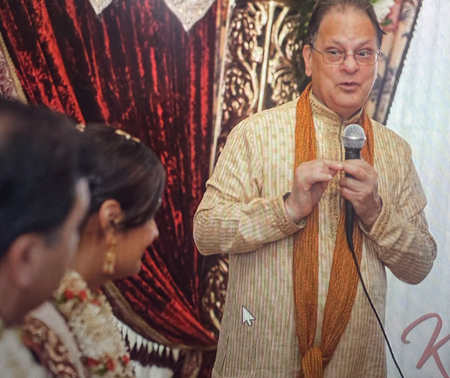
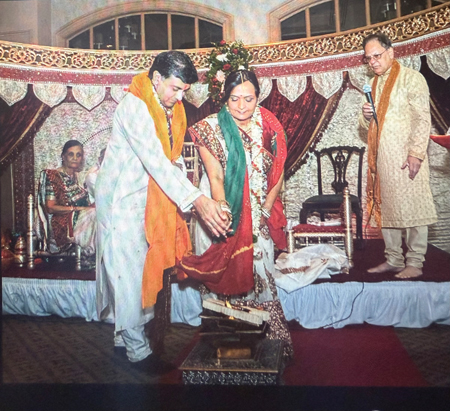 “After the wedding, senior family members told me that, for the first time, they truly understood the meaning of the vows they had taken decades earlier,” says the author, reflecting on Dr. Majmudar’s unique and instructive style in conducting the wedding rites of his son, Rajen, and daughter-in-law, Sangeeta.
He was also a remarkable priest, having conducted the marriage of more than 450 couples. His ceremonies were never mechanical but deeply meaningful. I was a guest at one such wedding where the groom was Indian and the bride was Jewish. With his trademark humor and warmth, Bhagirathbhai welcomed everyone —even making the Rabbi feel not just included but celebrated. He could make people laugh and then fall silent with awe, as he spoke truths that resonated across traditions.
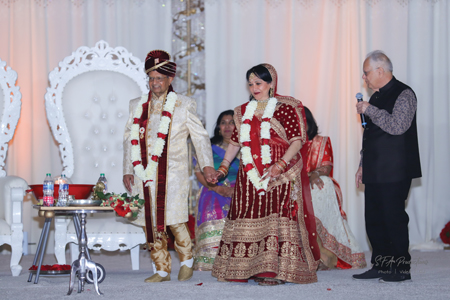 He never treated a wedding as a one-day assignment. He stayed with families, bonded with them, and built lifelong relationships, making every connection personal and lasting. When he presided over weddings, he had a gift for unlocking the sacred within the ordinary. He translated Sanskrit passages into words that touched the heart. He reminded couples that marriage was not simply a ritual but the beginning of a profound journey.
[Right] “Madhu and I feel blessed that he was also the priest for the renewal of our vows at our 60th anniversary,” writes Dr. Sheth.
Young people were drawn to him because he took the time to explain the meaning behind rituals and shlokas, helping them understand the reasoning behind them. When he performed the marriage ceremony for my son, Rajen, and his bride, Sangeeta, his words elevated the moment beyond celebration into a sacred memory. After the wedding, senior family members told me that, for the first time, they truly understood the meaning of the vows they had taken decades earlier. That was the power of his gift. Madhu and I feel blessed that he was also the priest for the renewal of our vows at our 60th anniversary.
As a professor, he won numerous teaching awards at Emory, but what made him a great teacher went far beyond plaques and honors. In my own research, I have found that all great teachers share three qualities: passion, compassion, and expertise. He embodied them all. He was passionate about every subject he taught, and his enthusiasm filled the classroom. He cared deeply for his students, listening intently, understanding their body language, their unspoken questions, their struggles. His knowledge was vast and unmatched. Honors such as the distinguished service award for lifetime contributions to medicine and women’s health, as well as his consultancy to the World Health Organization, only hint at the infinite wisdom he carried. He was, without question, a master of his field and yet always a student of life.
Bhagirathbhai’s breadth was astonishing. Religion, Sanskrit, medicine, philosophy, poetry—he carried deep knowledge of all of these, and more. Yet his greatest gift was not what he knew, but how he used it to elevate others. “Take a grain of wheat and make it into bread, its value increases threefold. Take a rough diamond, polish it, and its value multiplies fifteen to twenty times. But take a human being, mentor them, motivate them, help them realize their own potential— their value becomes infinite.” That is precisely what he did. That was his life’s work: unlocking the potential of others.
To me, and to so many, he was a giant—but also a friend, a mentor, a bridge-builder, and a guide. His contributions to the Indian, Atlanta, and Emory communities are immeasurable. His legacy cannot be counted in numbers or words. It lives in the students he inspired, the couples he united, the communities he built, and the countless lives he touched.
Yes, we will miss him. But more than that, we will carry him—in our hearts, in our families, in our communities, and in the better world he left behind.
Dr. Jagdish N. Sheth is the Charles H. Kellstadt Professor of Business at Emory University’s Goizueta Business School, globally recognized for his scholarly contributions in consumer behavior, relationship marketing, and competitive strategy. He is a recipient of the 2020 Padma Bhushan, one of India’s highest civilian honors, and has authored over 300 papers and several influential books.
A Life of Dharma, Service, and Joy
A brief biography of Dr. Bhagirath Majmudar
“Life is not to be measured by its length, nor feared for its ending, but embraced for its fullness. To live with love, to teach with joy, to serve with compassion—this is how the soul becomes eternal.”
These words reflect the life of Dr. Bhagirath Nanubhai Majmudar (January 29, 1938 – August 15, 2025). Affectionately remembered as a physician, poet, playwright, and priest, he lived eighty-seven years with gratitude and fearlessness, carrying India in his heart while embracing America as his home.
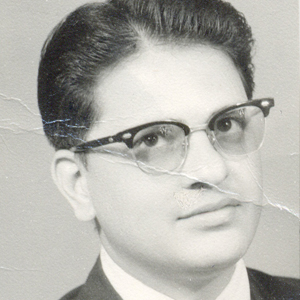
[Right] Bhagirath Majmudar, as a distinguished-looking young man in Ahmedabad, 1957.
 Born in Nadiad, Gujarat, to Nanubhai and Pramila Majmudar, his brilliance was evident from the start. He ranked first in both Sanskrit and mathematics, earned the Jagannath Sheth Gold Medal, and filled auditoriums as a prize-winning orator in Gandhi-inspired elocution competitions. It was during a debate at the age of seventeen that he met Uma Mehta, who would become the love of his life. Their marriage of sixty- three years was a true partnership—one of affection, faith, and shared purpose.
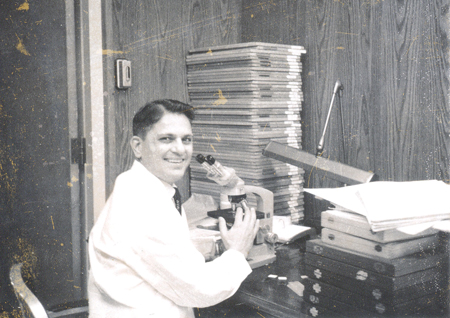
[Left] During his medical residency in Salem, Massachusetts, 1968.
After earning his medical degree in India, he and Uma left for America in 1967 with their young daughter, Nija. Their journey echoed that of so many Indians of his generation— arriving with little more than determination and hope, but carrying within them the values of hard work, learning, and service. His career spanned Salem Hospital in Massachusetts, Ohio State University, and ultimately Atlanta, where their second daughter, Sangini, was born and where he spent four decades at Emory University and Grady Memorial Hospital.
At Emory, he became legendary for his teaching. Generations of students and residents honored him with awards, culminating in the university’s highest accolade, the Evangeline Papageorge Distinguished Teaching Award. In 2017, the Georgia Obstetrical and Gynecological Society recognized him with its Distinguished Service Award for his lifetime contributions. Yet he often reminded students that medical knowledge alone was not enough, that true doctors must heal with compassion. “The proudest moment,” he once said, “is when my students argue with me because they have learned enough to think for themselves.”
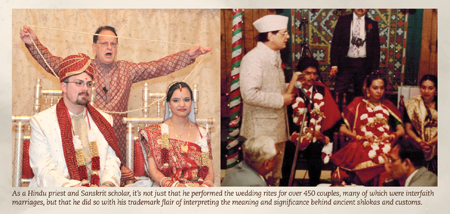
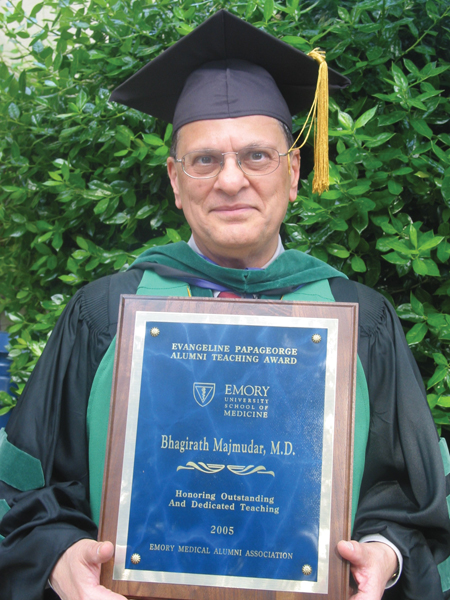
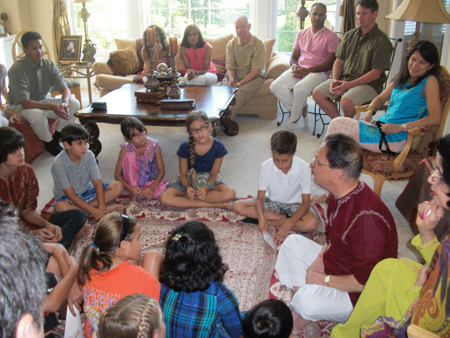
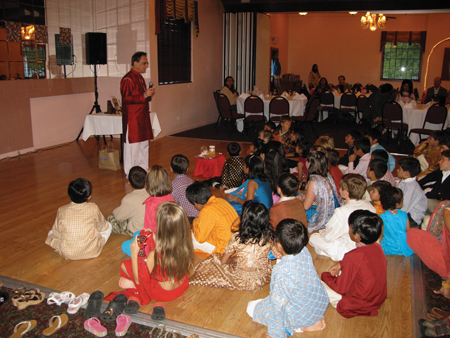
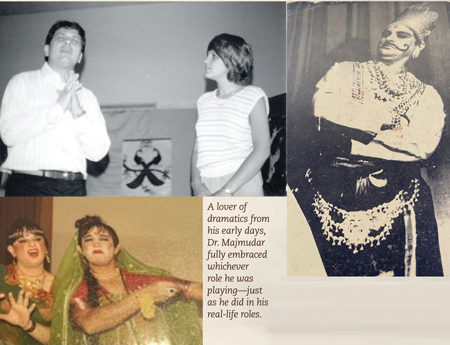
[Top] Dr. Majmudar was a passionate advocate for passing on the significance of culture and tradition to the next generation.
 Beyond the hospital walls, Dr. Majmudar gave abundantly to the Indian community in Atlanta. As a founding member, president, and board chair of the India American Cultural Association (IACA), he created cultural classes for children and staged original plays that celebrated Indian identity while bringing the community together. He wrote in English, Sanskrit, Hindi, and Gujarati—essays, poetry, and drama— that gave voice to both his heritage and his humanity.
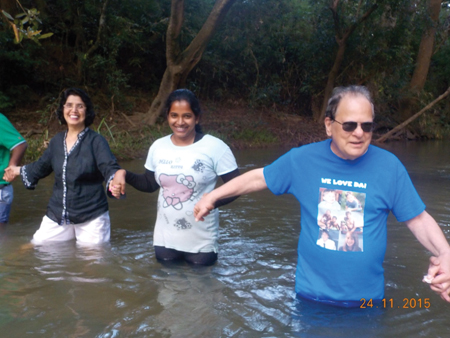
[Right] The ever-youthful Bhagirath and his wife, Uma Majmudar, trekking the River Kaveri in Coorg, India, during their post-retirement travels.
 As a Hindu priest and Sanskrit scholar, he officiated more than 450 weddings, many of them interfaith, blessing couples with wisdom and warmth. He also lent his voice to interfaith dialogues, including during the Atlanta Olympics, and was often invited to temples, churches, synagogues, and civic forums. For the Indian community in Atlanta, he was both anchor and bridge, helping new generations stay connected to their roots while also embracing the wider world.
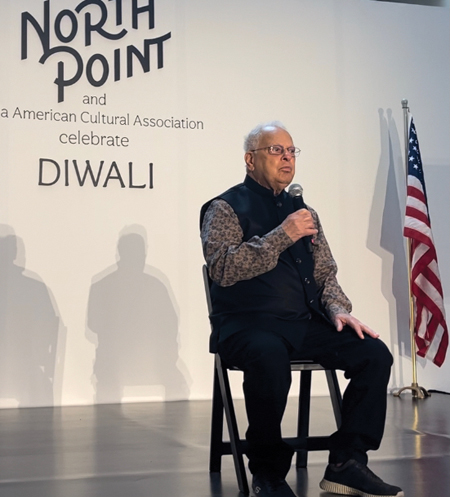
[Left] He was frequently sought out to interpret Indian traditions to American audiences. He is seen here talking about the significance of Diwali at Northpoint Mall in Alpharetta, Georgia.
In his retirement, Dr. Majmudar reflected on life’s impermanence with clarity. “Once our dreams are fulfilled, our next goal should be to help others fulfill theirs,” he wrote in a widely-read essay. Retirement, he believed, was not an ending but an opportunity to deepen family ties, nurture creativity, and give back even more selflessly. His words resonated with many Indians who, like him, built careers abroad yet measured success not by wealth or titles but by what they gave to others.
For all his public roles, his greatest joy was private: his family. With Uma, he raised Nija and Sangini, and embraced Joseph Meyer and Ilja Bedner as beloved sons. He delighted in his four grandchildren—Hans, Arya, Indra, and Bodhi—who knew him simply as their beloved “Da” who was always playful, wise, and endlessly loving.
 It felt fitting that he left this world on August 15th—India’s Independence Day, Swatantrata Divas—as if his soul had chosen a day of freedom to begin its onward journey. And in keeping with his lifelong devotion to learning, he donated his body to medical education, offering one final gift to the field he loved.
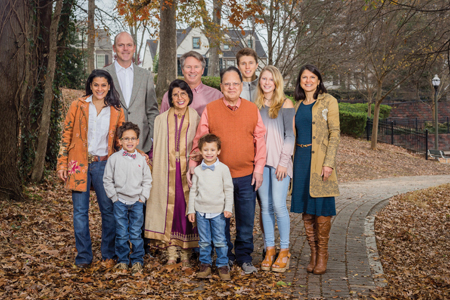
[Right] Bhagirath and Uma Majmudar with their family: Daughter Sangini Majmudar Bedner (leftmost) with her husband Ilja Bedner and sons Indra and Bodhi; daughter Nija Majmudar Meyer (rightmost), with her husband Joe Meyer, and children Hans and Arya.
Dr. Bhagirath Majmudar’s life was a reminder that one could be fully Indian and fully American, and that the measure of a life is not found in honors or titles, but in the love, wisdom, and humanity carried forward by those whose lives you touch.
This article was prepared by our editorial team, based on responses provided by the Majmudar family. An expanded version, including eulogies from several of the numerous individuals whose lives were touched by Dr. Majmudar, is available online at www.khabar.com. A “Celebration of Life” event will be held on Saturday, January 17, 2026, at 2:00 PM at Emory University’s Glenn Memorial Sanctuary. All who wish to honor his life are welcome.
Friends and Family Remember Dr. Bhagirath Majmudar
An Influencer Like No Other
Far from today’s trend-driven social media influencers with their impersonal reach, Dr. BHAGIRATH MAJMUDAR touched hundreds of lives through genuine personal connections—radiating infectious optimism, wit, wisdom, and selfless compassion.
By Parthiv N. Parekh
As the founding partner and editor of Khabar magazine, I’ve had the privilege of witnessing—and chronicling—the growth and evolution of the Indian community in metro Atlanta for nearly three decades. Over the years, we’ve shone a spotlight on hundreds of remarkable individuals across diverse fields, each distinguished by their impressive accomplishments and accolades.
The reason Dr. Bhagirath Majmudar stands out as a giant among them in my mind is that his stature stemmed not from his many titles and accomplishments, but from who he was at his core—brilliant, learned, wise, and generous with his time, attention, and care. He was one of those rare individuals who, while firmly grounded in pragmatic reality, remained relentlessly upbeat in outlook. True to his name, his aura was indeed “immense.”
Our family was fortunate to have met Bhagirathbhai and his wife, Umaben, during our early days in the U.S., about 40 years ago. Each of them, on their own, was a breath of fresh air; together, they were a true dynamo of positivity and kindness. Over the years, our family has been among the many fortunate beneficiaries of a close and cherished relationship with the Majmudars.
 It began when Bhagirathbhai entrusted my mother—who was just starting a home-based catering business—with her first major order: preparing food for 250 guests to celebrate a milestone wedding anniversary of the Majmudars. By then, he had met my parents on a few occasions and had also sampled my mother's cooking. Yet, to place such faith in a newcomer, cooking out of a small apartment kitchen, and for an occasion so special, spoke volumes about his trust and generosity of spirit—and his judgment.
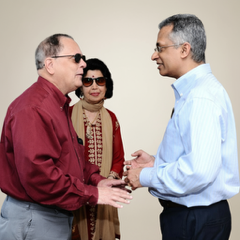
[Left] Drs. Bhagirath and Uma Majmudar at the inauguration of Khabar’s new office in Duluth, Georgia, in 2014.
More than 20 years ago, when I found myself at a crossroads—faced with the difficult choice of giving up one of my two professions because it had become impossible to sustain both growing ventures—I turned to Bhagirathbhai to think it through. I explained that, from a purely financial standpoint, continuing my residential real estate career of nine years offered greater potential for building wealth. But doing so would mean letting go of my association with Khabar magazine, as both now demanded full-time commitment. I shared my dilemma with him: while real estate promised a more lucrative future, it didn’t inspire me in the least. As someone with a lifelong affinity for writing, my heart was deeply invested in Khabar.
After asking several thoughtful questions—and confirming that choosing to continue building Khabar at the expense of the more financially rewarding real estate career wouldn’t place my family’s well-being at risk—he offered a gem of foresight that instantly brought clarity and confidence to my decision. He observed that rebuilding a real estate career, even after several years of being out of it, was far easier than doing the same with Khabar. Ten or 15 years down the road, he said, if I wanted to go back into real estate, I could; but rebuilding a community magazine, once phased out, would be almost impossible. That single, brilliant insight made the decision to continue with Khabar a no-brainer. And for that, I (and I hope thousands of our readers) are grateful to him.
There have been hundreds who have benefited from Bhagirathbhai’s medical expertise, which he generously shared along with his time, with anyone in need. When my father suffered a stroke several years before his passing, Bhagirathbhai visited him daily during his official rounds at Grady Memorial Hospital. Those visits meant the world to my father. To us, he was that trusted “family member” we could always turn to for informed second opinions and sound guidance on treatment options. And beyond his medical insight, the warmth, wit, and positivity he brought to the hospital room were an enormous source of comfort and strength for us, and especially my father.
This spirit of giving never waned. A couple of years later, when my father was diagnosed with bladder cancer, Bhagirathbhai accompanied us to appointments with the urologist and the oncologist, both of whom he knew personally. Even when he couldn’t be physically present, knowing we could call him anytime to talk through treatment options meant the world to us—both psychologically as well as in practical decision-making.
Beyond our personal relationship with him, it was a great privilege to witness his impact across so many facets of community life. The rites, rituals, and Sanskrit shlokas at the hundreds of wedding ceremonies I had attended over the years had always felt inaccessible—and, to be honest, somewhat tedious—until I found myself at a wedding where Bhagirathbhai was the presiding priest. He not only translated the Sanskrit verses into English but also shed light on the symbolic meaning behind the rituals we had taken for granted since childhood.
Bhagirathbhai was one of the Atlanta Indian community’s foremost interpreters of Indian culture, tradition, and heritage—and a vital voice in the city’s interfaith circles. He was also an impassioned reader of, and contributor to, Khabar magazine. Years ago, when Khabar was recognized as the “Best Community Voice” in Atlanta Magazine’s annual “Best of Atlanta” edition, it was his article that earned special mention:
“There are plenty of lifestyle features (we loved a recent cover story on Indian weddings that showed a lavishly costumed groom riding a horse in front of a local Westin), but what really sets this independent publication apart is its thought-provoking commentary, such as an essay by Emory professor Bhagirath Majmudar on whether Indian Americans are racially prejudiced against other ethnic groups in the United States.”
In this age of social media dominance—where viral posts garner millions of clicks—it is the kind of personal and enduring influence embodied by Dr. Majmudar that reminds us of a timeless truth: quality matters far more than quantity. There are hundreds of friends and family members whose lives he touched who are acutely feeling the void left by the passing of this “Bhagirath” soul. To them—to all of us—I leave this image: him savoring a glass of Johnnie Walker Black, eyes twinkling with that familiar spark, gently reminding us, “Don’t mourn my loss—celebrate my life.”
“One of a kind” is far too simple a term to describe him
By Siddharth “Bintoo” Desai
Growing up, I never quite understood the depth of respect my parents had for Bhagirath Uncle. It felt almost like a mystery. Only later did I realize just how completely that respect was earned — and how extraordinary he truly was. Unlike many relationships that remain polite and distant, mine with him only grew deeper and more meaningful as I grew older.
For a long time, I struggled with religion. I wondered if not being particularly religious made me a bad person. One evening, over his favorite Johnny Walker Black, Bhagirath Uncle changed that for me. He told me, “As long as you live your life caring for others and simply being kind, it doesn’t matter whether you believe in Hinduism, Islam, or Christianity.” That conversation stayed with me. From that day on, I stopped worrying and started living by his words — carrying that lesson every single day.
He wasn’t just cool — he was mad cool. Name another uncle, let alone a priest, who would sit with me for hours talking about Malcolm X? Everyone talks about MLK, but Malcolm X? That was our thing.
After I graduated from college, our conversations about Malcolm X became a tradition. For five years, they would pause and resume every time we met. At one wedding he officiated, he handed me a copy of Malcolm X’s autobiography as a gift. To this day, it sits on my bookshelf beside my own copy — a reminder of our bond and of his lesson to never judge.
There are only a handful of people I instinctively looked for at any event, and he was always one of them. I made it a point for my kids to see him whenever they could. And of course, they loved him too.
He had a gift: the ability to impart wisdom without ever sounding like he was preaching — even though being a preacher was one of his roles. His words always landed with just the right weight. Never too heavy, never too light.
When I was considering marriage, he was the only one who told me, “Don’t rush. Take your time.” And after Jasmina and I had kids, he was the only one who asked if we were still making time just for us. In the chaos of new parenthood, that reminder meant everything. His advice was never generic — it was always thoughtful, always personal, always exactly what I needed to hear.
And then there was our wedding. The honor of having him conduct the ceremony is something I’ll cherish forever. What amazed me most was how no two weddings of his were ever the same. Each one was personalized, infused with his deep understanding of the couple. Nothing felt rehearsed or routine — it was alive, meaningful, unforgettable. And of course, he was probably the only pandit in the world who would share a celebratory drink with the bride and groom afterward. That was Bhagirath Uncle — equal parts tradition and joy, reverence and humanity.
Passionate Professor of Pathology and Our Family’s Trusted Guide and Mentor
Dr. Seshu Sarma
I first met Dr. Majmudar in the mid-1980s and immediately recognized him as a community leader and a man of wisdom. It was only after I began my training in the Department of Obstetrics and Gynecology in 1988 that I truly understood the depth of respect and admiration he inspired for his knowledge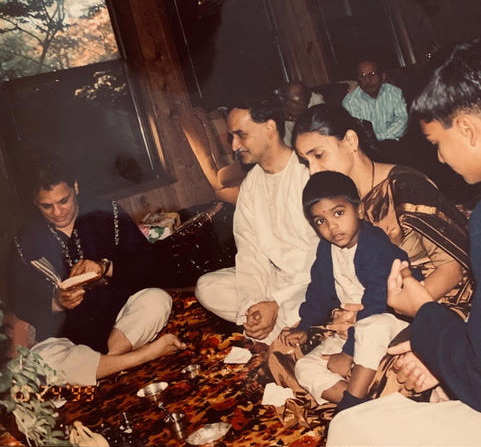 and exceptional teaching abilities. Each week at the Obstetrics and Gynecology Grand Rounds at Emory, where leading experts from across the country would present on reproductive health, Dr. Maj— as he was affectionately known— would deliver concluding remarks as the pathologist. His ten-minute analysis was considered the final verdict of the session and became a much-anticipated highlight. Both speakers and the audience eagerly awaited his insights, always enriched with wit and wisdom.
[Right] Dr. Majmudar performing Sriram Sharma’s Namakaranam (Naming Ceremony).
On a personal level, my family was privileged to experience his generosity and affection firsthand. When we brought our youngest son, Sriram, home in 1999, Dr. Majmudar insisted on hosting his Namakaranam, the traditional naming ceremony. He welcomed many friends, officiated the event himself, and celebrated it in a beautifully authentic style. Together with his wife, Dr. Uma, he treated us all to a memorable feast. It remains one of the most significant events in our lives. That same year, Dr. Majmudar invited Sriram to their home in costume for Halloween, ensuring the celebration was filled with joy, blessings, and lasting memories.
Over the years, I came to rely on his wise counsel and expertise, especially through Sriram’s high school and college years. When our older son, Gopal, entered Emory Medical School, Dr. Majmudar stepped in as an indispensable mentor, providing unwavering support every step of the way.
A Transformational Mentor
By Dr. Gulshan Harjee
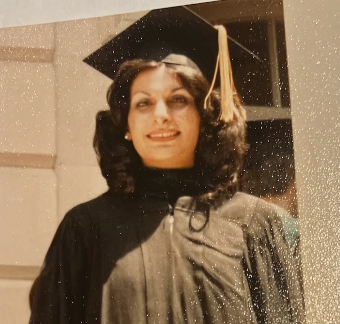
I am deeply saddened to learn that my first mentor and professor, whom I met in my pathology classes at the Morehouse School of Medicine in 1979 and 1980, has passed away. His presence in my life was transformative, and I remain eternally grateful for the encouragement he offered throughout my career. His words were not mere words, but sparks of belief that carried me forward through moments of challenge and doubt.
 At Emory University School of Medicine, he shaped the careers of countless clinicians. His students were not simply taught medicine; they were mentored into becoming healers. With his rare gift of blending rigorous science and profound spirituality, he instilled in us not only knowledge, but also character, compassion, and humility—qualities that reflected his own remarkable journey.
[Left] Dr. Gulshan Harjee, from her time in medical school.
His lectures were unforgettable, not only for their medical insight but also for the way he infused them with language and passion, and they lingered long after class ended. That was his gift: transforming medicine into a calling and learning into a joy.
His influence was both broad and profound, and his legacy remains deeply ingrained. For those of us fortunate enough to have known him, his memory will never fade. May his soul rest in eternal peace.
Words Cannot Fully Capture Him
By Monika and Sonia Nikore
We loved him beyond words. His laughter still echoes in our minds. We remember his joyful spirit, his Krishna-like teasing: “You know I love you more, but don’t tell her.” We see him even now — listening intently, head slightly lowered, giving his full, undivided attention to whoever needed him: Papa, the kids, us. He was always there, always present.
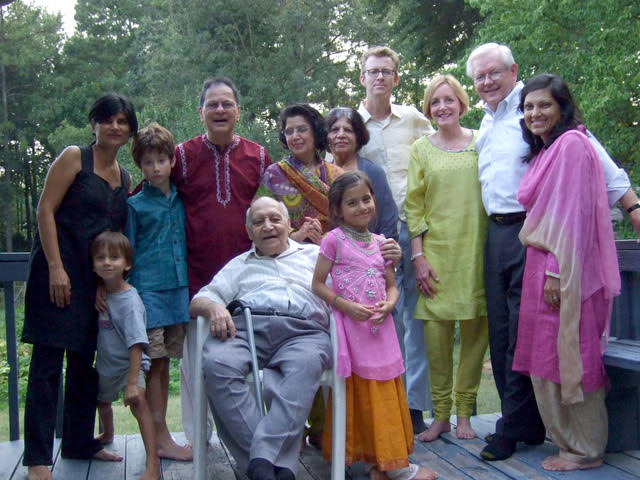 The tears don’t stop, because the heart aches to see him, to hug him, to be with him… just one more time. And yet, even one more time would never be enough. Uncle and Mashi were part of every milestone in our family — weddings, births, graduations, anniversaries, pujas, every celebration. He anchored us like a rock.
[Right] The Nikore family with Dr. and Mrs. Majmudar.
For more than 40 years of annual pujas, he guided us with wisdom: “Joy has to be created; we can’t sit around waiting for it.” He reminded us to celebrate whatever milestone each year offered. His steady presence carried us through illnesses, losses, and struggles — always calling, always checking in, always guiding.
His love and wisdom have seeped into our bones and into our children’s. They feel his loss deeply, yet they also know his legacy lives on. We see him still — smiling, that twinkle in his eye, saying, “Hanh, Sonia and Monika Beta.”
Uncle had so many facets and such depth. Words can never fully capture him. You had to experience him.
His Lasting Legacy for the Next Generation
By Tej Munshi
I feel truly fortunate to have had the privilege of knowing Dr. Majmudar during my formative years. His presence left an imprint that has stayed with me through the years.
I will always remember the stories he told around Diwali. Those evenings were more than festive gatherings — they were moments of wisdom, laughter, and warmth that brought everyone together and reminded us of the deeper meaning of family and community. His gift for storytelling had a way of making even the youngest among us lean in, and much of how I think about religion today is rooted in those memories.
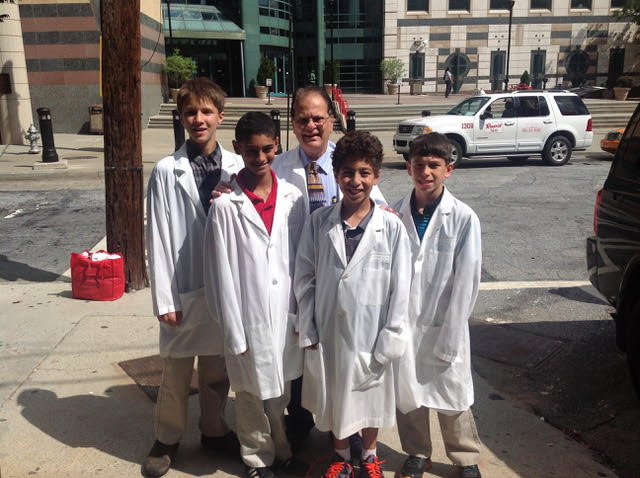 I also remember the pride in his voice as he showed us around his lab at Grady Hospital. As a middle schooler, I didn’t fully grasp it at the time, but I now understand how much it meant to him to share his world with his grandson and his friends. Despite being an accomplished scholar and physician, he was genuinely excited to answer all of our questions — no matter how small — and to weave in stories from his remarkable career.
[Left] Tej Munshi and friends with “Dr. Maj” during a day at Grady Hospital
In many ways, Dr. Majmudar reminded me of my own grandparents. Their shared humility and their desire to leave a lasting legacy for the next generation connected our families in a special way. He was a rare soul — someone who made those around him better simply by the way he lived. His legacy lives on in every lesson he shared, every story he told, and every life he touched. He will be remembered with deep respect, gratitude, and love.
Enjoyed reading Khabar magazine? Subscribe to Khabar and get a full digital copy of this Indian-American community magazine.