


Letters from Readers

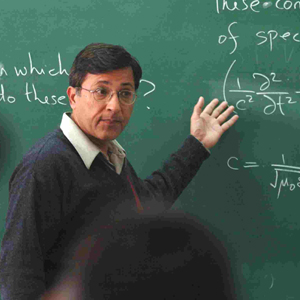
[Left] Dr. Pervez Hoodbhoy
Where the truth lies in Indo-Pak conflicts
Most scientists have been opposed to nuclear proliferation. Regarding the Indo-Pak conflict, the esteemed scientist Dr. Pervez Hoodbhoy has formed his opinion without a historical understanding of the conflict. According to him, the reason for the Kargil war was India’s development of nuclear weapons. “Kargil would never have happened,” he says in his interview with Khabar (“Pakistan’s Voice of Reason,” July 2025 issue). He has ignored the fact that Pakistan and India fought two major wars (1965 and 1971) well before India tested the nuclear weapon in 1974.
In 1965, the Pakistani army launched an invasion, crossing the LOC (Line of Control) in Kashmir. That forced the Indian army to fight along the LOC and also expand it further to the south. After fierce fighting, the Indian army was able to cross the Ichhogil Canal, putting Lahore International Airport within range. Then, diplomatic intervention by the then-U.S.S.R. and the U.S.A. resulted in an immediate ceasefire. Pakistan’s Ayub Khan and India’s Lal Bahadur Shastri met in Tashkent (Uzbekistan) and signed a peace treaty facilitated by Soviet Premier Kosygin. Both sides pulled back to the pre-war position. Although both sides claimed victory, India had gained nearly 3 to 1 territorial advantage.
Genesis of Kargil war: India’s then-prime minister, Atal Bihari Vajpayee, and Pakistan’s Nawaz Sharif had developed a friendly relationship and discussed a permanent solution to peaceful co-existence. In February 1999, Vajpayee went to Pakistan and met Nawaz Sharif. They signed the Lahore Declaration pledging to resolve outstanding issues, including the issue of Jammu and Kashmir, through peaceful negotiation. That did not go well with the army and became a prelude to the Kargil war in May 1999. General Pervez Musharraf overthrew Nawaz Sharif’s government in a coup d’état and proclaimed himself the chief executive of Pakistan under martial law. Kargil war was similar to the 1965 war—except that the Indian army pushed back the Pakistani army behind LOC, but did not cross LOC due to diplomatic pressure from the U.S. President Clinton.
When it comes to the relationship with India, the decisions are made by Pakistan’s army generals, not by the prime minister and nor by the scientists. That’s why there were so many wars. After 1971, when Pakistani army suffered a humiliating defeat, they resorted to sending terrorists with the goal “to bleed India with a thousand cuts.” As long as cross-border terrorism continues, there is no possibility of any dialogue that may produce peaceful co-existence between the two nations.
India’s nuclear weapons: It must be mentioned here that India developed nuclear weapons mainly as a deterrent to nuclear-armed China, which has been pursuing an aggressive expansionist policy. China invaded and took over Tibet and later invaded India in 1962, only a few years after signing an agreement with India in 1954 for peaceful co-existence.
Surendra Nath Pandey
by email
Interested in writing for Khabar?
Writers are invited to contact us at editor@khabar.com for submission guidelines. Please include links and/or attach copies of published articles, if any, as samples of your work. A review of our back issues online will give you a good idea of what we like to publish. Pitches or unsolicited articles that haven’t appeared elsewhere are welcome as well. If there is further interest, Khabar will respond with an offer or provide more information on our requirements.
What’s on YOUR mind?
We welcome original, unpublished letters from our readers. You could either respond to a specific article in Khabar or write about issues relevant to our community. Letters may be edited for length and other considerations. Longer submissions by readers may be considered for the “My Turn” column.
Email: letters@khabar.com • Fax: (770) 234-6115.
Mail: Khabar, Inc. 3635 Savannah Place Dr, Suite 400, Duluth, GA 30096.
Note: Views expressed in the Letters section do not necessarily represent those of the publication.
Enjoyed reading Khabar magazine? Subscribe to Khabar and get a full digital copy of this Indian-American community magazine.