


Punjabi farmers now dominate the mozzarella trade, and Keralite priests, nuns, and nurses are familiar faces in churches and hospitals in Italy. Despite its modest size and its lack of clout, the Indian diaspora in Italy is a visible lot.
‘Love-India’!
No, that’s not some quirky T-shirt slogan, it’s the
affectionate nickname for Lavinio, a small, Italian seaside
town about 50 km from Rome. The nickname has
been bestowed by the local Italians—thanks to the
surprisingly large Indian population that’s settled
here. ‘Love-India’ is a place of gurudwaras and langar
prasad, bhangra and Bollywood. It’s no surprise to stumble
across a Nagar Kirtan procession here. Or for that
matter, a kabaddi match.

(Right) With a tote bag full of samosas
and kachoris, a Tamil street
vendor at the Leaning Tower of
Pisa. (Photo: Lavina Melwani)
During my recent travels across Italy, I encountered
Indians from Rome to Venice to Siena. My most
surprising and memorable encounter was at the Leaning
Tower of Pisa. There, in the midst of a tsunami of
international tourists, stood a wiry man from Chennai,
selling samosas and kachoris from a tote bag dangling
from the handles of his bike!

Sikhs (left) form the overwhelming majority of Indian immigrants in
Italy. (Photo: Sikhi Sewa Society, Rome, Italy)
As I traveled and enjoyed
the cuisine, the wine,
and the museums of Italy,
on a parallel track, I always
had my Indian antennae up
to spot desis in their new
habitat. Though not present
in large numbers, I met Indians
from all walks of life—as
farmers, promoters of Italian
culture, and as tourists visiting
the country.
The India-Italy connection
To fully understand the
influx of Indians into Italy,
it was necessary to go back
in time. When I left New
York for Italy on a summer
holiday, the only Italian connection
I knew of was Sonia
Gandhi, the President
of Congress Party, India’s most storied political entity.
The road in her native town of Orbassano is called ‘Via
Rajiv Gandhi,’ after her husband, the former Prime Minister
of India. Orbassano is close to the city of Turin, and
Sonia Gandhi’s family still lives there. There are a few
other well-known Indian-Italians living in India: Dino
Morea, supermodel and actor, and Shiva Keshavan, a
five times Olympian and luge champion, for example.

The Indian Ambassador to Italy,
Anil Wadhwa (center), speaks to
business leaders in Tuscany.
(Photo: courtesy, Indian Embassy
of Rome)
Eager to know more, I dropped in at the architecturally
splendid Indian Embassy in Rome to meet
with Ambassador Anil Wadhwa. Over cappuccino, he
shared fascinating insights and details on the Indian
presence in Italy. “No one knows how to make Indian
tea here,” he joked.
“Italy is a country with whom India has had very
deep commercial and economic ties,” he pointed out.
“Between 2007 and 2012 Italy was the No. 1 one trade
partner of India both in terms of investments as
well as trade.”
In 2012, a chill set in between the two nations
when two Italian marines were implicated in the killing
of Indian fishermen in Indian territorial waters. Now,
with the return of the marines to Italy to await trial,
diplomatic ties have seen a revival. Recently, high level
ministers from the Modi government were in Rome for
the canonization of Mother Teresa, an occasion to restore
the old cordiality.
“We have a roadmap for the future,” said Wadhwa.
“The main focus is on the economic side—investments
and cutting-edge science
and technology, design, and
we have traditional areas
of cooperation which is
in leather, textiles, gems,
and jewelry. The embassy
has organized about 12 focused
commercial events in
various Italian cities. Currently
we are also talking
about $3 billion in contracts
and about joint manufacturing,
too.”
Meet the first Indian historian
in Italy, and more—a diversity of profiles
The Indians who have
settled in Italy have very distinctive
stories about their
journey. While official numbers
are unavailable, the
Indian Embassy there estimates
the Indian population of Rome at about 25,000.
One of them is Sanjukta Das Gupta, who was earlier
teaching at Calcutta University in India. She moved
to Italy when she married an Italian colleague. She
now teaches at the Department of Oriental Studies at
La Sapienza University of Rome. She says that she is
the first Indian historian in Sapienza.

(Left) Trevi Fountain, Rome.
(Photo: Lavina Melwani)
“The best part of Italy for me is that I live amid
so much visible history,” she says. “Almost every road
takes you to some site dating back to ancient times.
But Rome is not only about the past, but the past blends
in with the present. This for me is the greatest fascination
of Italy.”

(Right) A gathering of Sikhs in Navaro.
(Photo: Sikhi Sewa Society)
Ask her about the Indians
in Italy and she divides
them into several
categories. There’s migrant
labor—mainly from Punjab.
They are spread mostly
in the agricultural regions
in the north, around
Rome, in the Lazio region,
and also down south in
Naples, Bari, and Sicily.
There are restaurant workers who are
predominantly Punjabis, and religious
migrants or priests and nuns, mainly
from Kerala, who work in churches or
with the Vatican.
Another set of Indians are those
working in different UN organisations,
the ‘international’ set, so to speak. Then
there are the spouses—Indians married
to Italians—and a floating population of
students. She mentions that there are a
few academics working in the management
schools, in the ecumenical schools,
and also some who are in the spacedesign
industry.
According to statistics,
the majority of the
Indians are farmers from
the Punjab, doing exactly
what they did back
home: farming. Almost
95 percent of the Indians
here are in agriculture.
Such is their significance
to the cheese-making industry,
that in a case study
titled, “Indian Diversities
in Italy,” by Kathryn Lum,
for the European University
Institute, she states
that according to the leaders
of the Coldiretti region,
“without [the Punjabi migrant workers]
the emblematic Italian cheese industry
would be at risk.”

A Punjabi souvenir seller at the
Trevi Fountain in Rome. (Photo:
Lavina Melwani)
The South Asian presence is quite
noticeable since Italy has taken in a
large number of refugees. There are
Bangladeshis boys selling everything
from tourist trinkets to roses on the
sidewalks, and there are many Pakistani
tour guides. Indians are also a big
part of the tourism industry. Be it at the
Trevi Fountain or the Vatican, you cannot
help noticing the Indians, Bangladeshis,
and Pakistanis promoting tours
and hawking souvenirs.

(Right) The Tuscan countryside. (Photo:
Lavina Melwani)
Our 14-member group of family
and friends stayed at Torre del Santos, a
beautiful old villa in the village of Barberino
Val d’Elsa at the edge of the hamlet of
Petrognano, about a half-hour from the
must-see cities of Siena and Florence.
The Tuscan countryside is dotted with
medieval villages, marketplaces, wineries,
and restaurants. On my very first
night I discovered that the Italian owner
of the villa had been to India, and her
teenage daughter is passionate about
India and Indian food!

(Left) Balbir Singh Pabla works in
the leather industry in Tuscany,
and is also helping his local
municipality in promoting
tourism to the area. (Photo:
Lavina Melwani)
Of the several Sikhs with whom I
connected in Tuscany, one was Balbir
Singh Pabla who worked with Italian
leather goods designers. I learned a lot
about how our Indian migrants function:
he had brought his leatherworking
skills and habits of hard work with him,
had maintained his culture, family, and
religion and yet had become a part of
the Italian municipality and was helping
to promote the local area to tourists.
Through our villa owner, I met Balbir
Singh Sangha, who is an Italian chef
with some of the best T-bone steaks in
town! Sangha, who came from Hoshiarpur
in the Punjab in 1989, came to Italy
as a farmer. He had gone back home for
an arranged marriage to Parmjeet Kaur,
who is a housewife, and now has grown
children in their 20’s. Gradually he got
into cooking and for the past 20 years
has worked in restaurants in
Rome and Tuscany. He now cooks
everything Italian—though at
home it is always Indian food
cooked by his wife.
The Hindu presence is apparent,
too, in Italy, though much
less than that of the Sikhs. Vishnu
Kumar Soni, who deals in the export
of scrap metal to India, is one
of the devotees helping to build
a Sanatan Dharma Mandir in Lavinio,
in the municipality of Anzio. There are
already two temples in Rome and there
has been a good response to the building
of this new temple, he says. “Hindus
from different parts of Italy come
together in Lavinio for jagrans, Krishna
Janamashtami, Navratri, and a weeklong
Diwali festival.”
The Indian Italian diaspora:
the big picture
Unlike the U.S., Italy is not a nation
of immigrants. Nor does it have the historic
ties with India that England does.
Not surprisingly, the size of the Indian
immigrant population in Italy is modest
compared to these two nations. According
to the Bureau of Labor Statistics,
there are over 150,000 Indians in Italy—
in contrast to the close to 4 million in the
U.S. A large majority of them, about 80%
by some estimates, are Punjabis.
Qualitatively, Indians in Italy can be
seen as two distinct groups: the farmers
in rural areas who are living in close-knit
enclaves, virtually recreating India in
Italy; and the professionals, diplomats,
and academics who form a big part of
the urban Indian-Italian population. The
latter are forced to assimilate perhaps
more so and faster than in America because
of the lack of a massive number
of Indians to congregate with and form
groups with.
Not only is the Indian diaspora in Italy
small, but it is also relatively nascent.
Not surprisingly, Indians are not a visible
force in politics, entertainment, business,
academia, and other fields—the
way they are in the U.S. and in England.
In fact, small business entrepreneurship,
the signature element of most Indian
diaspora communities around the
world, is largely absent here. A notable
exception is a small number of restaurateurs
who are starting to make their
presence noticed.
An Indian ethos—cricket, gurudwaras,
and Kathak in the town square
The lack of numbers or clout hasn’t
stopped Indians from indulging, quite
visibly, in their culture and heritage.
Vishnu Kumar Soni came many years
ago as a tourist, liked it, and decided to
stay on in Anzio. He went back to India
to get married and brought his family
to Italy. He says, “The young Italians
are not into agriculture or construction,
but our people coming here are ready
to do any kind of work, and are already
comfortable in agricultural activities
from India.” As he points out, ‘Love-India’
(Lavinio) has 16 Indian and 11 Pakistani
spice stores because there are so
many South Asians there!
There are about 52 gurudwaras in
Italy, and some local governments have
also given land for stadiums to play
cricket. There are also cultural festivals
where groups perform on the beaches,
and some shows from India. A Kathak
performance by danseuse Shovana Narayan
attracted a crowd of 1,200 in the
town square.
Culture curry: Bollywood, yoga and
mixed marriages
Bollywood is also a spicy presence
in Italy. While eating in a wayside café
or shopping in stores, my attention was
often captured by a desi ad or programming
popping up occasionally on regular
Italian TV. In the past, Kabir Bedi, who
played the lead role in the hit TV series
Sandokan, was a popular celebrity. In recent
times, the actor was honored at the
River to River Indian Film Festival in Florence
where the Bollywood film Mohenjo-Daro, in which he also stars, premiered.

(Left) Indophile Selvaggia Velo is the
founder of ‘River to River Indian
Film Festival’ in Florence. She is
seen here with actor and director
Rajat Kapoor. (Photo: courtesy, Ambili Abraham)
The River to River Festival is now in
its 16th year. I got in touch with Selvaggia
Velo, who is the founder and driving
force behind the festival. Why is she so
passionate about this event? “Indian
films hardly get a release in Italy, and the
festival is one of the only places where
you get to see such films. It all happened
by chance. I liked India and cinema and
decided to put the two things together;
so with study and dedication, passion,
intuition, and many other things, now
we have just finished our 16th edition!”
Ambassador Wadhwa observed that
a lot of Bollywood film shootings take
place in Italy: “There’s a place called Matera,
which is famous for Biblical films
because the houses are in rock caves
in the hillsides. It’s a very peculiar kind
of setting—the whole town is made of
stone, so it’s an ideal place for those
kinds of films. But many Indian films
have also been shot there.”
Ambili Abraham, an Indian dancer,
has built her career on the Bollywood
craze. She runs a dance school in Rome.
Her father, who earlier worked in the Indian
Embassy in Rome, is from Kerala,
and her mother is from Mizoram. Abraham
picked up dancing when she was
five and for the past 16 years has been
conducting classes and workshops all
over Italy. The majority of her students
are Italians, but also Indian children
who have been adopted by Italian families
and are in search of their roots. This
year she worked with 140 students on a
dance campus in Ancona, organized by
La Luna Dance Center.
Abraham’s Bollymasala Dance Company
has taught students who have now
graduated and become teachers themselves!
She has often been on Italian
TV and is reputed to be the one who
brought Bollywood dance to Italy. She
says, “I have been blessed by students
who really give me lots of love and respect.
Italy is now my second home. My
main aim is to make my students love
the Indian cinematic world and make
Italians understand the power of Indian
cinema. After a month of dancing, they
may say ‘I love Shah Rukh Khan!’ That
does make a difference to me!” Abraham
shared with me that an Indian-Italian
couple has opened another Bollywood
dance school in Rome now, called Bollywood
Club.
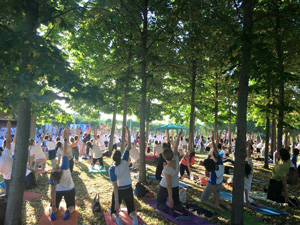
International Yoga Day at
Auditorium Parco della
Musica, a popular music
complex in Rome. (Photo:
Indian Embassy of Rome)
With so many Indians around, can
mixed marriages be far behind? There
are several Indian women marrying Italian
men; more so than the other way
around. Italian men often come back
from India with an Indian wife. Roshni
Sekhar came to Italy 30 years ago, after
she married her husband Paolo Quircio,
who was then working for Alitalia
in Delhi. The couple have two children,
Maitreya and Flaminia Bhavani, and
have devoted themselves to propagating
yoga in Italy. Sekhar, who is a direct disciple
of Swami Vishnudevananda, noted
follower of Swami Sivananda, runs the
Centro Yoga Swami Vishnu and has also
taught Hatha Yoga for the Sivananda
Teachers Training Course in Italy.
She says, “We spread peace through
yoga and we take demonstrations, theory
classes, and practice classes to the
high schools, to give a correct overall
view of yoga to the young. Also, every
year, through various cultural activities
by raising funds, we support animal organizations
in India and help in the support
and cure of street animals.”
Yoga has indeed caught on in Italy.
Says Sekhar, “Teaching in Italy was not
easy when I started 25 years ago. In the
beginning, most students would come
for the physical benefits only. Now, a lot
of people come for spiritual benefits, too.
Also, Italy is the mystic heart of the West,
and the Italian land has that sacred
power, which India has.”
Samosas on the Tiber

Indian restaurants have mushroomed
all over Italy. There are several
in the Termini Station area in Rome and
in big cities like Florence and Milan. Yet,
as Ambassador Wadhwa pointed out,
while Indian food has caught on, there’s
plenty of room for growth in the upscale
category as most existing restaurants
cater primarily to Indian group tours.
(Right) Mahendar Singh
Chauhan, posing in front of
Jaipur, his popular restaurant in
the tourist district of Trastevere,
near the Tiber River. (Photo:
Lavina Melwani)
One of the popular restaurants is
called Jaipur, in the tourist district of
Trastevere, near the Tiber
River. Come evening, the
place springs to life with
its many bars, cafes, and restaurants.
Mahendar Singh Chauhan has run the
restaurant with his brother and brother-in-law for 14 years. Since it was my last
day in Rome, I still wanted to eat Italian
food, but who can resist a plate of crisp
samosas and chutney? Jaipur’s samosas
were big and succulent, the décor opulent.
On the night I visited the place, it
was full of Indians. There was a grand
buffet laid out and the air was redolent
with the aromas of home.

(Left) Gondoliers in Venice. (Photo: Lavina Melwani)
A natural affinity
Happily, the tourism trade between
the two countries is thriving. “I think the
Italians feel a natural affinity towards
Indians and vice versa,” says Wadhwa.
“They like the spirituality, they like the
people, they like the food, they like the
color, as far as India is concerned. And
Indians find Italian designs very fascinating.
The cities are very beautiful;
there is a lot of history and art here. Both
countries are actually rich in art and history,
so there’s a natural affinity.”

(Right) Venice, the floating city. (Photo: Lavina Melwani)
As he points out, the common factors
are the beauty of the country, and
the richness of a very ancient civilization:
“It’s a very beautiful culture and
there are very strong family-minded
people here, very similar to what India
has. That is something very unique in
this country.”
I tried to get a feel of the real Italy
by taking trains, buses, and
trams wherever possible.
I walked the streets wherever
I could. We found our
way around by asking for
directions from Italians and
desi strangers. When we
were headed to the tourist
hotspot of Trastevere, a
talkative Bangladeshi street
vendor guided us to the
bus we should take. On the
bus I met a friendly young
Indian girl, the daughter of
Sikh farmers. She had left
the rural outreaches of Rome behind to
live in the big city and study at university.
She spoke fluent Italian and some
English and one could see her future
was right here, far from the mustard
fields of the Punjab.
Lavina Melwani is a writer for several
international publications. She blogs at
www.lassiwithlavina.com.
Follow @lavinamelwani and
www.facebook.com/LassiwithLavina/