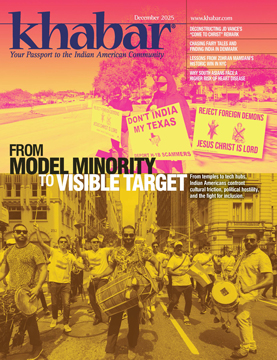


From Model Minority To Visible Target

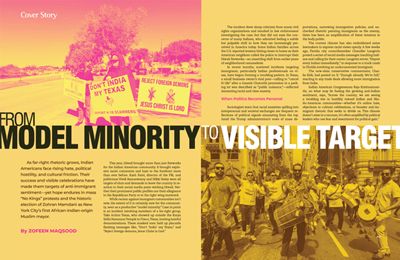
As far-right rhetoric grows, Indian Americans face rising hate, political hostility, and cultural friction. Their success and visible celebrations have made them targets of anti-immigrant sentiment—yet hope endures in mass “No Kings” protests and the historic election of Zohran Mamdani as New York City’s first African-Indian-origin Muslim mayor.
This year, Diwali brought more than just fireworks for the Indian American community. It brought explosive racist comments and hate to the forefront more than ever before. Kash Patel, director of the FBI, and politicians Vivek Ramaswamy and Nikki Haley were all targets of slurs and demands to leave the country in reaction to their social media posts wishing Diwali. Neither their prominent public profiles nor their allegiance to the Republican Party or to the right-wing mattered.
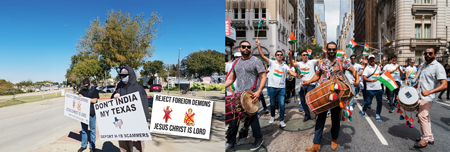
Demonstrators representing Take Action Texas, a far-right group, displaying anti-Hindu and anti-India placards outside a Hanuman Temple in Frisco, Texas. (Photo: facebook.com/TakeActionTexas)
While racism against immigrant communities isn’t new, the extent of it is certainly new for the community, seen as a productive “model minority.” Case in point is an incident involving members of a far-right group, Take Action Texas, who showed up outside the Karya Sidhi Hanuman Temple in Frisco, Texas, hosting hateful demonstrations. These masked men held up placards flashing messages like, “Don’t ‘India’ my Texas,” and “Reject foreign demons; Jesus Christ is God.”
The incident drew sharp criticism from many civil rights organizations and resulted in law enforcement investigating the case, but that did not ease the concerns of many Indians, who admitted feeling a subtle but palpable shift in how they are increasingly perceived in America today. Some Indian families across the U.S. reported tension hitting closer to home as their American neighbors called the police to interrupt their Diwali fireworks—an unsettling shift from earlier years of neighborhood camaraderie.
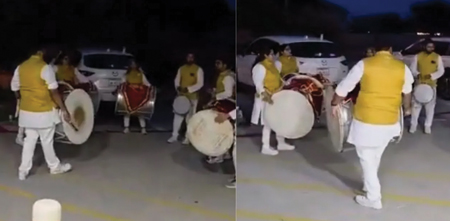 In recent months, scattered incidents targeting immigrants, particularly Indian professionals on visas, have begun forming a troubling pattern. In Texas, a small business owner’s viral post—calling to “cancel H-1Bs” after a Ganesh Chaturthi procession in a parking lot was described as “public nuisance,”—reflected simmering racial and class anxiety.
[Right] In Lewisville, Texas, an X user posted a video of the Ganesh Chaturthi celebration in the parking lot of a retail shopping strip that includes an Indian grocery store, tagging city officials to alert them of the “public nuisance.” (Photo credit: @Avidandiya on X)
When Politics Becomes Personal
Sociologists warn that racial anxieties spilling into interpersonal and societal exchanges are frequent reflections of political signals emanating from the top. Amid the Trump administration’s vows of mass deportations, narrowing immigration policies, and unchecked rhetoric painting immigrants as the enemy, there has been an amplification of these tensions in the body politic.
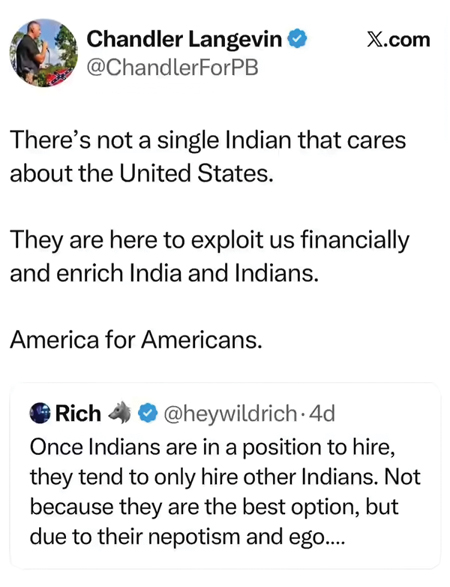
The current climate has also emboldened some lawmakers to express racist views openly. A few weeks ago, Florida city councilmember Chandler Langevin posted a series of social media messages insulting Indians and calling for their ouster. Langevin wrote, “Deport every Indian immediately,” in response to a truck crash in Florida involving an undocumented immigrant.
The now-slain conservative commentator, Charlie Kirk, had posted on X: “Enough already. We’re full,” reacting to any trade deals allowing more immigration from India.
Indian American Congressman Raja Krishnamoorthi, on what may be fueling the growing anti-Indian sentiment, says, “Across the country, we are seeing a troubling rise in hostility toward Indian and Hindu-American communities—whether it’s online hate, objections to cultural celebrations, or broader anti-immigrant rhetoric that seeks to divide us. This climate doesn’t arise in a vacuum; it’s often amplified by political leaders who use fear and resentment for political gain.”
 Researchers have noted that a rapid rise in the immigrant population often reveals economic and social fault lines. A Migration Policy Institute research report titled, Understanding and Addressing Public Anxiety about Immigration, revealed, “Rising anxiety about immigration overlaps with a variety of concerns, including economic security, changing cultural norms, crime, and the ability of the government to effectively manage these challenges.”
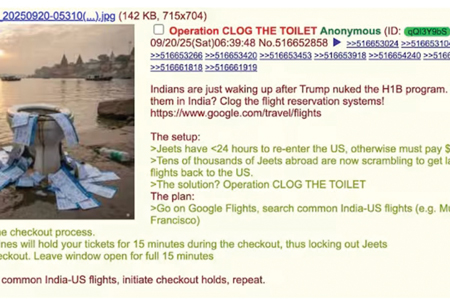
[Left] As part of a campaign titled “Operation Clog the Toilet,” 4chan, a right-wing forum, posted detailed instructions on how to prevent Indians on H-1B visas from returning to the U.S. by faking mass flight bookings.
According to the International Migration Outlook, 2025 report a number of developed countries have set explicit objectives to reduce high migration inflows. They have made asylum systems more restrictive, and are reviewing their international student policies, with some tightening admission and post-study rights.
Job Takers or Job Creators?
In September, far-right trolls on 4chan and other platforms launched Operation “Clog the Toilet”—a coordinated effort to block Indians on H-1B visas from returning to the U.S. by faking mass flight bookings and overwhelming airline systems. The campaign coincided with Trump’s shocking and controversial executive order imposing a $100,000 fee on H-1B holders. The idea behind the campaign was to exploit the chaos to stoke anti-India sentiment and inflate ticket prices on India–U.S. routes.
In fiscal year 2024, the U.S. approved approximately 400,000 H-1B visas. Out of this, Indians received 283,397 visas, accounting for about 71 percent of all visa approvals. Amid Trump’s close allies, the H-1B program has become a hotbed of controversy. It is increasingly being flagged by the ruling political establishment as a program that displaces American workers with cheaper foreign labor.
 Florida Governor Ron DeSantis, in appearances on Fox News, called the H-1B program a "total scam," adding that companies are laying off large numbers of Americans while also hiring new H-1B workers." Public perceptions are, not surprisingly, turning against this program. A recent survey by Rasmussen Reports also found that 48 percent of U.S. voters approved of President Trump’s controversial $100,000 fee for new H-1B visa applicants.
South Carolina-based Aneri Desai, a career strategist for international students and immigrants in the U.S., offers thoughts on why the perception of these tech workers as “job snatchers” is flawed: “H-1B professionals are not just arriving and taking away jobs. Many have already spent years contributing economically while in school. Many immigrants are job creators, employing millions of American workers. In the technology sector alone, immigrants have founded more than half of all billion-dollar startups.” She adds, “For decades, Indians in the United States were viewed through a narrow and outdated stereotype of doctors, engineers, or IT workers. Today, they are founders, CEOs, digital creators, investors, and small business owners. They are not just part of the economy but are actively contributing to it and growing it.”
“Visible Minority”—an Easy Target
With 51.9 million immigrants, representing 15.4 percent of its total population, the United States remains home to the largest immigrant community in the world. Among them, about 5.2 million are of Indian origin, according to the 2023 U.S. Census Bureau report. Just two decades ago, that number was 1.8 million. The 174 percent surge has made Indians the fastest-growing immigrant group, even outpacing the overall U.S. immigrant population.
The story of Indian Americans began perhaps somewhat differently than that of other immigrants. Indians became the quintessential “model minority”—they were, broadly speaking, industrious, law-abiding, and prosperous, and perhaps most importantly, quiet, even subservient. Over time, Indians began charting their quiet success stories in America. They were the doctors, tech founders, and Ivy League achievers. But now, Indian Americans aspire to visible leadership roles—from CEOs to mayoral candidates.
 Shedding light on the recent anti-Indian incidents, Aditi Paul, founder of Dr. Paul & Company, a New York-based peer and expert mentorship network that helps immigrants navigate the EB-1 path- way to U.S. permanent residency, says there is a phenomenon that sociologists call the “visible minority” effect—when a distinct-looking group becomes the face of an entire community, feeling pressured to behave perfectly.
But things are shifting. With our growing numbers, we’ve become more visible collectively but less defined individually. That strength in numbers has given us the freedom to live more authentically—to celebrate, experiment, and even fail.” She adds, “And that seems to unsettle those in power. The rise in casual racism toward Indians reflects that discomfort. Zohran Mamdani’s mayoral win is another example of this shift—us choosing paths we were never “supposed” to take, stepping into spaces where we weren’t expected to belong.”
[Left] Palm Bay Councilman Chandler Langevin’s post on X — shoewn here in an image from a Times of India report before it was deletd — reflects blatant anti-Indian racism. In another now-deleted post, he went further, writing, “Deport every Indian immediately.”
The Fault Lines Within the Indian American Community
This can also be a moment of uncomfortable introspection for Indian Americans. Many social observers feel that expressing cultural pride and traditions needs to be balanced with care and consideration for neighborhoods and communities. In Queens, New York, this year, two houses caught fire due to Diwali fireworks, leaving the American homeowners understandably upset. Local news channels reported that in heavily Indian-populated neighborhoods like Edison in New Jersey, officials received 40 complaints and seven reports of fire breaking out. A family lost their home. This prompted the city mayor and fire chief to make a video warning residents to show restraint. In Canada, the city of Brampton registered 1,490 complaints to city officials related to fireworks and excessive noise, resulting in $45,200 in fines. This is despite a fireworks ban in place since 2022.
 In some other instances, the over-enthusiasm was not limited to festivals. There have been several viral videos from U.S. theaters showing fans littering the auditorium with confetti and empty plastic bottles, or creating a nuisance, while Indian and regional movies were playing. In Texas, fans held a coconut-breaking ceremony and a flash mob dance outside a theatre. In another incident, a 30-foot cutout of Pawan Kalyan, deputy chief minister of Andhra Pradesh, was brought inside a theater in Dallas to celebrate the release of a movie based on him. There have been other public inconveniences as well. A family performed a havan in their garage, scaring neighbors into calling the fire department. Large celebratory dances and marches through residential blocks have also come to light.
Rajat Gupta, an Indian American, runs an Instagram channel, where he highlights instances of public inconvenience created by Indians across the U.S. From videos of Indians caught shoplifting to dumping garbage on a street corner to taking out cultural processions in the middle of residential blocks, his videos are shared thousands of times, often opening up discussion amongst Indians about the misuse of liberties of living in America.
When asked whether he thinks that the negative perception of Indians may have something to do with the political atmosphere, Gupta says, “While some Indians may blame Trump’s policies, the truth is that while Indians love to bring their culture with them, they have to be mindful of others. Americans are not used to certain things, and that includes noisy behavior on the streets, though it is common practice for Indians to celebrate anything. Unless we start paying attention to what works in a society and what can genuinely cause problems to others, we will be typecast, and that is what is happening today.”
First, They Came…
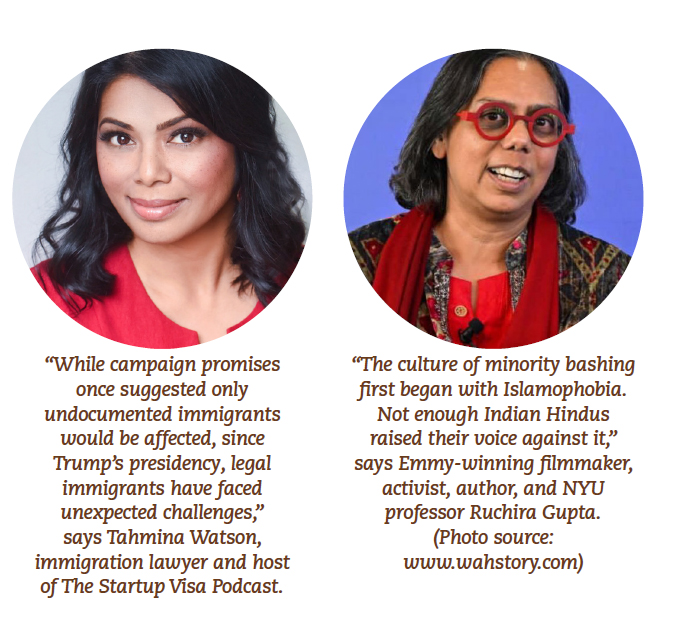
Emmy-winning filmmaker, activist, author, and NYU Professor Ruchira Gupta says, “This scenario reminds me of the famous German poem, ‘First they came for the Communists / And I did not speak out . . . Then they came for me / And there was no one left / To speak out for me’” Explaining her thought, Gupta says, “The culture of minority bashing first began with Islamophobia. The post-9/11 America saw anti-Islam propaganda to justify the wars—a wave on which Modi too rode later in India. Not enough Indian Hindus raised their voice against it.”
 Scholars also note that the Indian community’s inability to confront its own ethno-class sensitivities may have compounded the backlash. Like most immigrant groups, Indians in America exist in many microcosms. Not all are tech professionals or H-1B holders; many are taxi drivers, shop workers, and asylum seekers. Gupta explains, “The upwardly mobile Indians are often uncomfortable being bracketed with poorer Indians. The wealthy have sought to distance themselves from the working class in hopes of assimilating with the white elite—leaving the middle class adrift, with little support from either side.”
Another typical migration pattern that has persisted throughout history is that when a community arrives, it establishes social support mechanisms for subsequent arrivals. Gupta says, “When Latinos first came, they set up social services in their churches to help the next batch. However, Indians failed to set up any social or legal services to address problems. Even temples may or may not help depending upon which class or caste the one seeking help is from.” When divisions are apparent within a community, they become easy targets for bullying and backlash.
[Left] New York offered a rare and heartening countercurrent that cut through the national noise as the city elected its first-ever African-Indian-origin Muslim mayor, Zohran Mamdani.
(Photo: Wikimedia Commons)
A Glimmer of Hope As America Fights Back Against Anti-Immigrant Forces
Even as immigrant communities across the U.S. grapple with rising racial resentments and widening divides, earlier this month, New York offered a rare and heartening countercurrent. This moment of inclusivity briefly cut through the national noise. A mosaic of working-class progressives and ordinary citizens in New York City elected Zohran Mamdani, their first-ever African-Indian-origin Muslim mayor. This victory of a left-leaning progressive who ran on the promise of inclusion and a more equitable distribution of wealth stood in powerful defiance of a growing national mood characterized by suspicion and division.
This echoed another nationwide surge. A few weeks earlier, cities across the country had witnessed one of the largest ‘No Kings' protests. An estimated seven million thronged the streets throughout the nation, from Washington, D.C. to California, protesting against the Trump administration's immigration policies. With 2,600 ‘No Kings' events planned across every U.S. state, placards with messages reading, “Immigrants are welcome here,” were displayed across TV screens, clearly showing the people’s attitude about diversity.
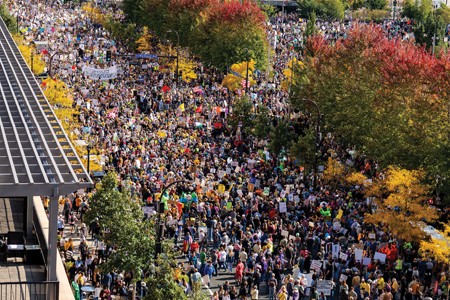
Millions thronged the streets from Washington, D.C. to California protesting against the Trump administration's immigration policies. Here, ‘No Kings' protest in Downtown Minneapolis. (Photo: Wikimedia Commons)
In downtown Chicago, a huge crowd of 250,000 people stretching across 2 miles showed solidarity with immigrants and people of color. As the crowd chanted inclusion, Chicago Governor J.B. Pritzker, addressing the rally, said, “Throughout history, we have learned that tyranny doesn’t arrive with dramatic proclamations. We learned that it comes wrapped in ‘law and order’... The reality here in Chicago is this: Black and Brown people are being targeted for the color of their skin. Children are being zip-tied and separated from their families. . . These people are not abstractions. They pay taxes on their businesses. They work hard—these people are the fabric of our society.”
Pritzker’s message and the massive turnouts at pro-immigration rallies captured the American paradox: a nation fractured by its fault lines, yet still capable of solidarity. Interestingly, it is within this very dichotomy that the true character of the United States emerges. Its fault lines expose deep divisions, yet its broader trajectory leaves room to accommodate diversity and, however imperfectly, offers hope that everyone can find a place.
Zofeen Maqsood is a U.S.-based journalist who writes extensively on millennial trends and expat issues. She has contributed to some of the most prominent media outlets in India and in the U.S.
Enjoyed reading Khabar magazine? Subscribe to Khabar and get a full digital copy of this Indian-American community magazine.