


"India Changed Me on a Molecular Level"

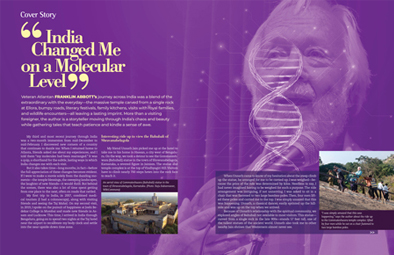
Veteran Atlantan FRANKLIN ABBOTT’s journey across India was a blend of the extraordinary with the everyday—the massive temple carved from a single rock at Ellora, bumpy roads, literary festivals, family kitchens, visits with royal families, and wildlife encounters—all leaving a lasting imprint. More than a visiting foreigner, the author is a storyteller moving through India’s chaos and beauty while gathering tales that teach patience and kindle a sense of awe.
 My third and most recent journey through India was a two-month immersion from mid-December to mid-February. I discovered new corners of a country that continues to dazzle me. When I returned home to Atlanta, friends asked me about my experiences, and I told them “my molecules had been rearranged.” It was a quip, a shorthand for the subtle, lasting ways in which India changes me with each visit.
But it also takes time—long months, in fact—before the full appreciation of these changes becomes evident. If I were to make a movie solely from the dazzling moments—the temple blessings, the sweeping landscapes, the laughter of new friends—it would thrill. But behind the scenes, there was also a lot of time spent getting from one place to the next, often on roads that rattled.
 My first trip to India, in 2007, combined medical tourism (I had a colonoscopy), along with visiting friends and seeing the Taj Mahal. On my second visit, in 2019, I spoke on the pursuit of happiness at Joshi Bedekar College in Mumbai and made new friends in Assam and Lucknow. This time, I arrived in India through Bengaluru, going on to spend two nights at the Taj hotel near the airport to recalibrate my body clock and settle into the near-upside-down time zone.
Interesting ride up to view the Bahubali of Shravanabelagola
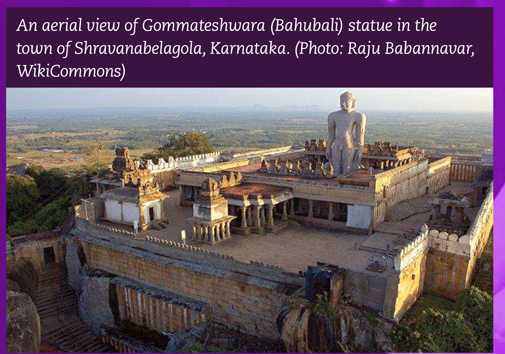
My friend Unnath Jain picked me up at the hotel to take me to his home in Hassan, a city west of Bengaluru. On the way, we took a detour to see the Gommateshwara (Bahubali) statue in the town of Shravanabelagola, Karnataka, a revered figure in Jainism. The statue and temple complex is at the top of Vindhyagiri Hill. Visitors have to climb nearly 700 steps hewn into the rock face to reach it.
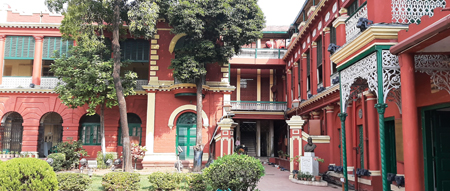
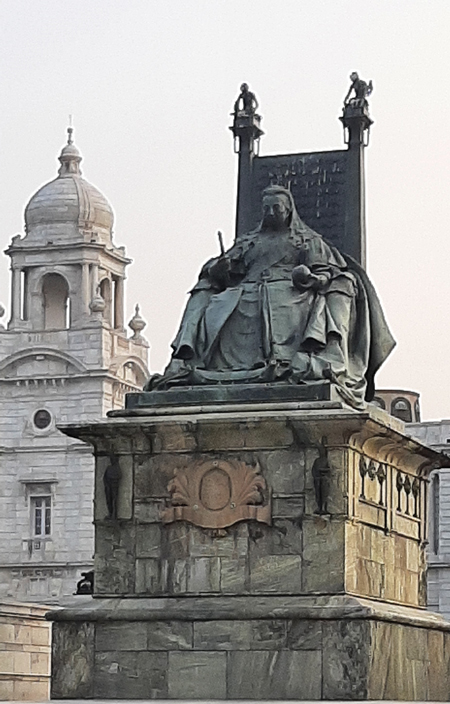 [Top] Kolkata sightseeing included Jorasanko Thakurbari, the sprawling haveli that was Tagore’s ancestral home; and [Left] the Victoria Memorial.
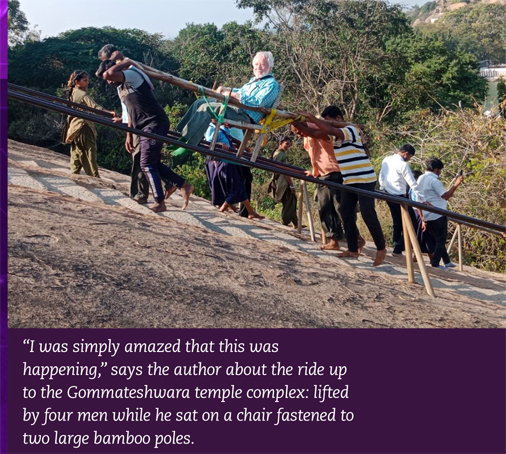
When Unnath came to know of my hesitation about the steep climb up the statue, he arranged for me to be carried up. I was weighed—because the price of the ride was determined by kilos. Needless to say, I had never imagined having to be weighed for such a purpose. The ride arrangement was intriguing, if not unnerving. I was asked to sit in a chair that was fastened to two large bamboo poles. Then, four men lifted these poles and carried me to the top. I was simply amazed that this was happening. Unnath, a classical dancer, easily sprinted up the hillside and was up on the top when we arrived.
Because of Unnath’s relationship with the spiritual community, we explored angles of Bahubali not available to most visitors. This statue— carved from a single rock in the late 900s—stands 57 feet tall, one of the tallest statues of the ancient world. Unnath also took me to other nearby Jain shrines that Westerners almost never see.
My time in Hassan with Unnath's family—his parents, brother, sister-in-law, and nephew—and friends was wonderful. An expert horticulturist, he cultivates hundreds of orchid species in the surrounding gardens. Above their living quarters is his Bharatanatyam dance school, where every afternoon I sat entranced as he taught groups ranging from beginners to advanced dancers. Unnath is as respected as a teacher as he is as a performer, and I could see that his students were in awe of him. As I watched him break down the components of Indian classical dance, I began to understand how each is a key to telling a story.
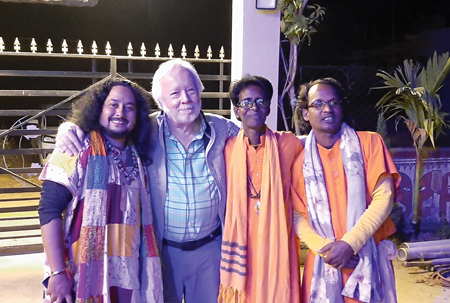
[Right] With Baul singer Raju Das Baul and his musicians at the author’s homestay in Santiniketan.
The grand Indian wedding at Fort William, Kolkata
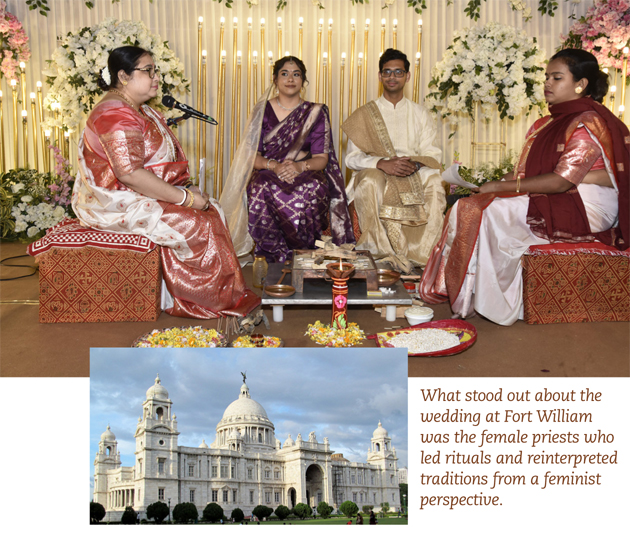
From Hassan, I flew to Kolkata for a grand wedding. Agniva Roy, a friend I met through his work with ASHA at Georgia Tech, welcomed me as a guest of his family. I knew his fiancée, Rodoshi Sinha, and was eager to witness the melding of their families. Agniva’s parents treated me with the famed Indian hospitality—accommodations at their club, transportation, and even a couple of stylish outfits. I attended intimate ceremonies at their home and the lavish formal wedding at Fort William, a venue so secure that foreign guests required advance clearance. What stood out about the wedding was the female priests who led rituals and reinterpreted traditions from a feminist perspective.
As part of my wedding gift, I arranged sightseeing for myself and the out-of-town guests during the over-the-top Kolkata holiday season with a profusion of Christmas light displays—more than I had ever seen. Highlights of the first day of sightseeing included Belur Math, the headquarters of Ramakrishna Mission; Jorasanko Thakurbari, the sprawling haveli that was Tagore’s ancestral home; and the Victoria Memorial. The next day, I immersed myself in the Indian Museum and the potters’ street of Kumartuli, where artisans fashion icons of gods and goddesses from straw and clay. It turned out to be one of the more amazing sights of my trip.
Tagore, Shantiniketan, and Baul style ektara music
A three-hour drive from Kolkata beckoned me next to see the famed Visva-Bharati University in the town of Shantiniketan, thanks to my interest in its founder, Rabindranath Tagore, the Bengali poet. Reaching this “Abode of Peace” required navigating the crush of holiday crowds. After touring the Tagore estate and university, I met Raju Das Baul, a resident of Santiniketan and a friend whom I had admired through social media. Later, I was to visit his home, but because traffic was so formidable, he and two of his musician friends came to my homestay instead for an evening of music.
 I had watched many of his videos, but seeing Raju and his troupe perform in person was quite a gift. The Baul style—which uses a one-string lute called an ektara—was rhythmic and melodic. The performance, along with their patchwork dress and dynamic dance, was difficult to compare to anything except flamenco, which at least gave me a faint point of reference for the passion and vibrancy.
I journeyed onward to New Delhi and Gurgaon, where the family of Kamla Dutt, my neighbor in Atlanta, welcomed me warmly. I reunited with her nephew Abhishek, and we ventured on a two-hour drive to Tijara Fort-Palace, an abandoned fort that has been transformed into a fairy tale resort with a grand dining hall and theater.
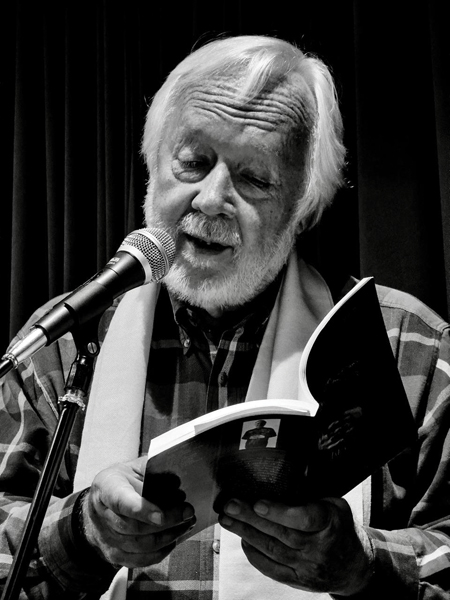
[Left] Poetry reading at the Existential Café, Chandigarh. (Photo: Diwan Manna)
Poetry readings at the Existential Cafe in Chandigarh
From Delhi, I went ahead to Chandigarh and met Kamla’s cousin, the celebrated journalist and poet Nirupana Dutt. Thanks to her, I participated in poetry readings in Chandigarh and later in Delhi. Chandigarh’s architecture and orderly planning, inspired by Le Corbusier, a Swiss-French architect, designer, urban planner, impressed me. The city’s modern museum elegantly blended old treasures and contemporary art.
 Evenings were spent at the Existential Cafe near Chandigarh University, immersed in a circle of remarkable poets and artists. Though much of the poetry was in languages foreign to me, the musicality and grace transcended meaning. Hearing Paul Kaur’s Punjabi verses was magical. Our reading at Delhi’s India International Centre gathered voices across English, Hindi, and Punjabi, each poem cutting deep and reverberating with shared experience.
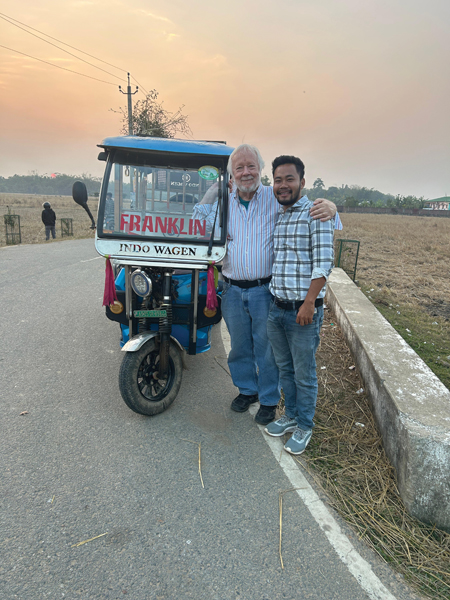
[Top] The author’s friend, Parag, an e-rickshaw driver from the Boro tribe, named his rickshaw after the author.
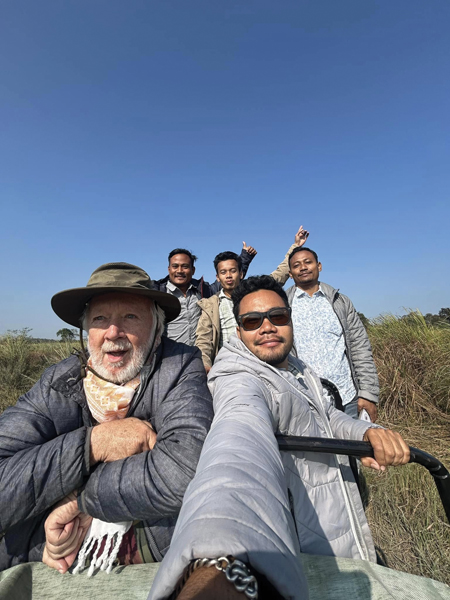
[Left] All set to chase rhinos at the Kaziranga National Park.
Hatari experience at the Kaziranga National Park
The village of Rani in Assam, thirty miles from Guwahati, the capital of the state, came next. Tranquil except on market days, Rani came alive with feasts and celebrations as the Bihu festival approached. My friend Parag, an e-rickshaw driver from the Boro tribe, lives with his mother and sister, and included me in the rhythms of their village life. Parag’s gift of an embroidered scarf, a custom of the Boro tribe, was one of the many beautiful mementos I received, along with many cups of tea shared with friends and family whom we visited.
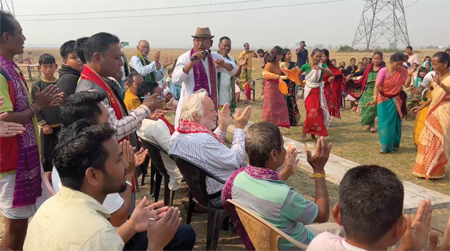
[Right] At a Bodo Bihu gathering, the author was asked, as the chief guest, to hand out live ducks as prizes to deserving youngsters.
Parag arranged a trip to the Kaziranga National Park, renowned for the endangered one-horned Indian rhinoceros. Riding in an open jeep called a “Gypsy,” we saw rhinos, had a close encounter with an elephant, and glimpsed myriad birds and animals. Venturing to neighboring Meghalaya, down miles of bumpy roads and steep hills, we reached a summit with a breathtaking 360-degree view—one of the trip’s most awe-inspiring moments.
Handing out live ducks as prizes at a Bodo Bihu gathering in Assam
Parag and his friends spoke some English, yet I often had no idea where I was going or what would happen next. I was swept from one spontaneous event to another. At a Bodo Bihu gathering, Parag’s cousin, who happened to be the Assamese pop singer Ankur Tanay, led me to the elders’ table and invited me to speak. Taken by surprise, I shared my honor at being there. Later, after traditional dances, I was asked to recite a poem.
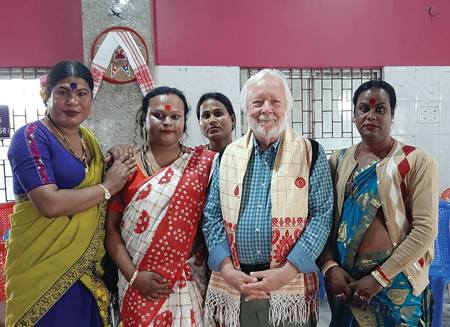 [Left] With hijras—the third gender community with a long cultural tradition in India.
The evening culminated with a prize distribution ceremony for the youngsters who had worked on the many projects in the community. As the honorary guest, I was asked to hand out the prizes. Up until handing out the cash prizes, all was normal. It was the set (flock?) of the second prizes that I wasn’t quite ready for—live ducks! I had never held a live duck, much less presented one. This soon became evident, much to everyone’s amusement, and so I was simply asked to bless the remaining ducks that were presented.
The wedding in the village was a striking contrast to Kolkata’s grandeur. Preparing food was a communal hive of energy. The bride's family hosted a pre-wedding event at a temple, where a group of hijras—the third gender community with a long cultural tradition in India—were present to bless the couple. I asked if I could be blessed too, and for a small contribution, I was.
Kailasanathar Temple: Carved underground from a single rock
 From Assam, I flew westward to Aurangabad, the gateway to the famous Ajanta and Ellora Caves that have been proclaimed World Heritage Sites. Unlike the rest of my trip, I had no personal connections here. My tour operators, SOAR Excursions, arranged a comfortable hotel and expert guides for the caves and city tour. The approach to Ajanta was a test in Indian travel: long stretches of bumpy roads, punctuated with sections of unfinished areas.
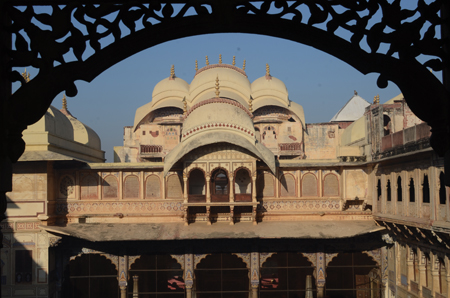
[Right] The author was a guest of Maharaja Krishna Chandra Pal and Maharani Rohini Kumari of Karauli at their City Palace, built in the 14th century in Alwar, Rajasthan.
The payoff was worth every bit of the trouble it took to get there. Dating from the 2nd century BCE to the 6th century CE, these caves—lost to the world until the mid-1800s—house exquisite paintings and sculptures. The Ellora Caves house the massive Kailasanathar Temple that has been carved from a single rock—an astonishing feat, especially considering the lack of modern technology.
 Aurangabad, now Sambhaji Nagar, bears the legacy of the feared Mughal emperor Aurangzeb. Bibi Ka Maqbara, the city’s most iconic place, is a tomb Aurangzeb made for his wife, now considered by some a saint. The tomb is a smaller and less splendid version of the Taj Mahal that his father, Shah Jahan, had built. The city is also renowned for its exquisite textiles, particularly the himroo fabric, which is woven from silk and cotton and prized for its use in sarees and shawls. I brought a treasured piece to carry home.
From Aurangabad, I chose to travel by car to Mumbai. I was glad to have had a number of road trips so that I could see the countryside. The highlight of the drive to Mumbai was a stop at the Sula Winery, where I was pleasantly surprised by the excellent quality of the locally-produced wine.
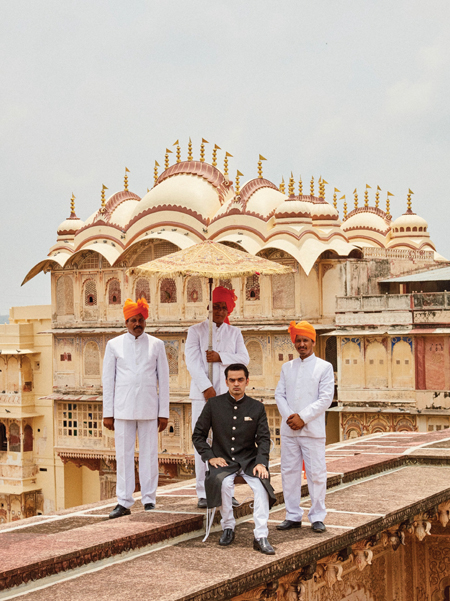
[Left] Prince Yuvraj Vivasvat Pal, posing royally atop the palace.
Revisiting my donated book collection at Joshi Bedekar College
My hotel in Thane, a suburb just north of Mumbai, was adjacent to a fancy hospital. This proximity to a “destination” hospital, the kind that medical tourists fly across continents to come to, almost made me search for a medical problem in myself that needed treatment. Thankfully, other than a few creaking joints, I was fine and in no need of a hospital, fancy or not.
 I soon turned to the purpose of my stop in Thane: to meet friends at Joshi Bedekar College, where I had spoken in 2019. Since then, I had shipped half my library—literally half a ton of books—across the globe on a tanker named Ivanhoe, traveling from the East Coast across the Atlantic, through the Mediterranean, Suez Canal, Red Sea, and Arabian Sea to Mumbai’s port. These books now form a special collection at the college’s Oriental Institute alongside ancient manuscripts and artifacts collected by the Bedekar family. Seeing cherished volumes from my college days available to students was deeply satisfying. The shipment included works by Atlanta authors Uma Majmudar, Kamla Dutt, and Murali Kamma, plus a year’s back issues of Khabar magazine.
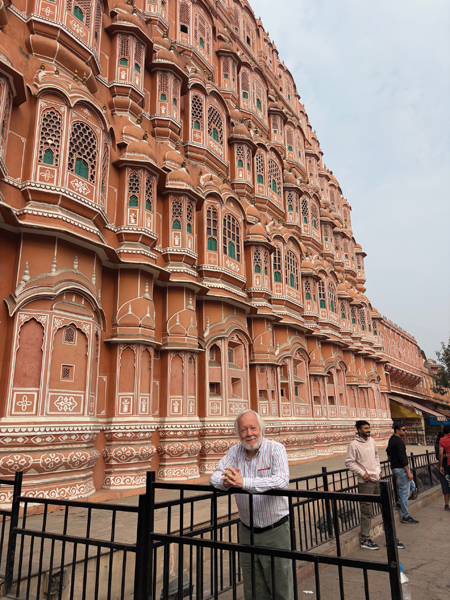
[Right] At the iconic Hawa Mahal in Jaipur.
Finding myself in Mumbai with a day that had no engagements, I took a boat to the Elephanta Caves from the Gateway of India, admiring another set of ancient stone carvings. On our return, we navigated massive crowds gathering for Republic Day festivities. My guide expertly threaded us through the throngs while I held my breath and followed. We capped the day with a wonderful Gujarati meal, and slowly, my overwhelm was replaced by a sense of calm, quite likely induced by satiation.
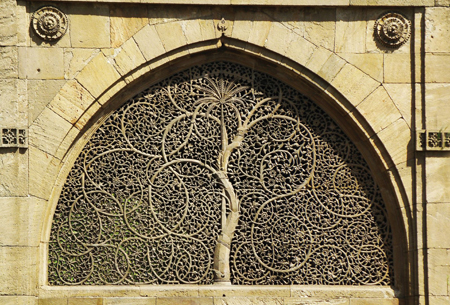
[Left] The famous jaali at the Sidi Saiyyed mosque in Ahmedabad. “Ahmedabad astonished me as one of the more pleasant Indian cities I visited,” says the author. (Photo: Raveesh Vyas, Wikicommons.jpg)
The royal family of Karauli: a fascinating blend of tradition and modernity
Next came Jaipur, where a driver sporting a grand Rajasthani mustache took me to Karauli. On my first trip to India, I was a guest of Maharaja Krishna Chandra Pal and Maharani Rohini Kumari of Karauli. At that time, their country palace hotel, where I had stayed, was in the countryside, on the outskirts of Karauli. Now, it has become engulfed by the city that has grown around it. To my surprise, the palace itself was still serene despite the urban growth around it.
 My royal friends greeted me warmly; we had kept in touch over the years. I met their son, Prince Yuvraj Vivasvat Pal, who had been away at school at the time of my previous visit. The vast city palace, which was built in the 1400s, and expanded over generations, was in the midst of a revival. Thanks to a renovation project that had started in 2007, there was much to see with paintings coming back to life and halls being returned to their bygone splendor.
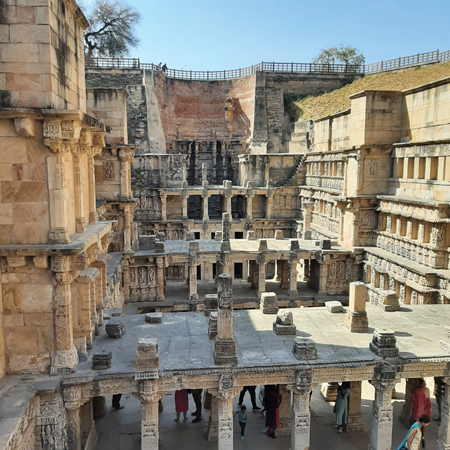
[Right] The Rani ki Vav (Queen's Stepwell) in Patan, Gujarat. (Photo: Aditya Roy)
The Maharaja has developed his land into an organic farm, where they raise dairy cattle and grow all the vegetables, wheat, and mustard seeds needed for their kitchen. The Maharani stays busy with civic engagement, such as organizing workshops enabling local women to produce clothing and crafts. She had previously also served as a district representative in the Rajasthan parliament. The Prince, a noted wildlife painter and a fashion icon who routinely 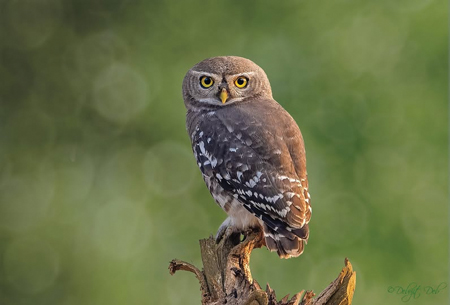 appears in Indian magazines, juggles raising a family and overseeing cultural events at the palace. Their family story is a fascinating blend of tradition and modernity that I was honored to experience.
[Left] The author describes the moment of spotting the elusive forest owlet in Gujarat as “precious.” (Photo: Aditya Roy)
A conversation between the grandsons of Mahatma Gandhi and Count Leo Tolstoy at the famed Jaipur Literature Festival
Back in Jaipur city, the Jaipur Literature Festival, among the world’s most renowned literary gatherings, beckoned. I met my friend, Professor Muddasir Ramzan, and together we navigated sessions packed with people. Arriving early for one talk was often key to securing a seat for the next. That is how I came upon the talk given by the British American journalist, Tina Brown, on England’s royal family. The festival, while increasingly international, featured many British presenters known to cofounder William Dalrymple, who was promoting his new book The Golden Road and was co-presenting alongside photographer Benoy Krishen Behl, who had been the first to document the Ajanta Caves. Behl's work is a treasure for art lovers.
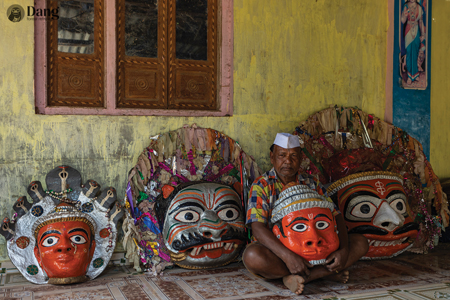
[Top] A mask maker with his papier-mâché masks (Photo: Aditya Roy)
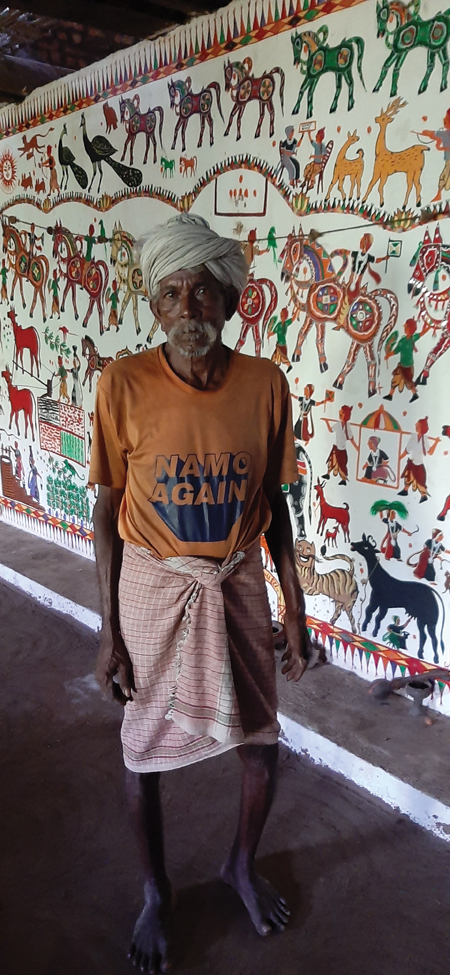
[Left] The shaman who is keeping alive the spirit-painting traditions with wall murals blessed by him. This one is at his home.
I attended a lively dialogue between historians Manu S. Pillai and Anirudh Kanisetti on Kanisetti’s recent book about the Chola Empire, Lords of the Deccan. Among the festival’s sweetest moments was a conversation between the grandsons of Mahatma Gandhi and Count Leo Tolstoy. Their grandfathers had corresponded during Gandhi’s South African activism and had profoundly influenced each other.
I had two chance meetings that delighted me: Abhishek Singh, who was promoting his book PURNAM: Stories & Wisdom of the Feminine Divine—he’d been artist-in-residence at Emory in 2018 and I had interviewed him for Khabar—and my Baul friend, Raju, performing alongside Susheela Raman.
Evenings shimmered with visits to the Amber Fort, another splendid World Heritage Site, and to the Jaipur royal palace and observatory.
Wildlife and cultural odyssey in Gujarat
My journey’s final chapter unfolded in Gujarat, a state new to me. I told Aditya Roy, my SOAR Excursions guide and travel partner for that leg of the journey, about my desire to see nature, especially the Little Rann of Kutch, heritage sites, and indigenous artisans. He crafted a perfect itinerary.
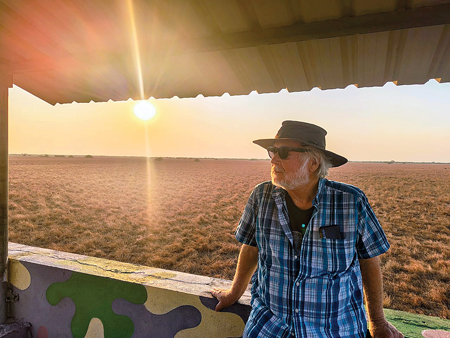 [Right] Sunset, from a watch tower in the Blackbuck National Park in Gujarat. (Photo: Aditya Roy)
Ahmedabad astonished me as one of the more pleasant Indian cities I visited. Kolkata crowded me, Delhi smogged me, Mumbai overwhelmed me—but Ahmedabad felt livable. I stayed in a lovely homestay called Fouzdar House, an art deco home built in the 1950s, where I spent hours with Aditya, his wife Niyati Kukadia, and fellow travelers sharing stories.
Niyati led me on a walking tour of old Ahmedabad, telling me about its rich history and showing me the famous Sidi Saiyyed Masjid. I learned that the city maintains over 40,000 bird feeders in public spaces. What a remarkable commitment! I wish I’d had more time to explore this fascinating city.
Aditya and I set off the next day on a wildlife and cultural odyssey. At the Little Rann of Kutch, I glimpsed birds I’d only seen in photographs. I also saw wild Indian asses—such lithe, elegant creatures. At Gir National Park, endangered Asiatic lions lounged with casual disdain for their human admirers. Blackbuck National Park introduced us to blackbucks, jungle cats, wild boars, and eagles. Along the way, heritage sites included the Sun Temple; the Queen’s Stepwell; and Lothal, one of India’s oldest excavated cities.
We spent a night at a palace hotel, where we met the Maharaja and Maharani of Jambughoda, a gracious older couple who are friendly with Aditya. On our way to the new lodge in Dang Forest, we visited two weavers in their homes, supported by governmental programs aimed at preserving traditional crafts. Tangaliya—a naturally-dyed cotton textile weaving technique—entranced me, and I purchased two pieces: one of which was later tailored into a shirt. The other type of cloth was silk ikat, where patterns are dyed onto the threads before they are loomed. This cloth is very intricate and exquisite.
We met an artist who is keeping alive the spirit-painting traditions with wall murals blessed by a shaman. We also visited a mask maker whose home was filled with large papier-mâché masks. Some were intended for festivals, while others were meant for films. The jumble of masks stared back at us in a surreal way.
My remaining days in India were spent at the Dang Forest Retreat, a boutique homestay beside the Ambika River. Every material used to build the lodge came from within seventy miles. It was a beautiful commitment to local ecological and artisanal traditions. The lodge’s open central space invited shared meals and conversation, while large bedrooms lined the ground floor. Furniture came from a bamboo factory supported by the SOAR team.
I met Aditya’s mother and SOAR partner, Sonal Mehta, who blends teaching design with advocacy for tribal artisans. Her workshop/factory lets students experiment with designs, then craftspeople work on the bamboo, uniting innovation with tradition.
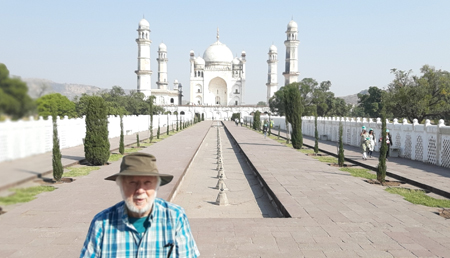
[Left] Bibi Ka Maqbara in Aurangabad, even though it was meant to be a replica of the Taj Mahal, falls far short of the splendor of the original in Agra.
On my final full day, Pavan Patel, Aditya’s naturalist colleague, took me to visit a famous spice store selling some of India’s finest turmeric, and into the forest to seek the elusive forest owlet—a species once thought extinct until rediscovered in the 1990s. Pavan’s expertise in the natural world paid off. We did see a spotted owlet staring back at us, and the moment felt precious.
India's last gift: “Walk like a cow”
India’s last gift came even as I was headed to the airport to catch my midnight flight home. Earlier in the evening, Aditya drove me to Mumbai, to my hotel near the airport. But India being India, the night was thick with festivity at my hotel. A wedding party spilled out in a riot of color and music, blocking exits all around—making the half-mile drive to departures nearly an hour long.
Traffic in India is a world unto itself. Cars share roads with rickshaws, motorcycles, cows, herds of livestock, oxcarts, camels, and even working elephants. Indian drivers display uncanny skill, navigating razor-thin margins, reading the flow. Timing merges with horn blasts like an intricate dance. The noise, the closeness, the chaos—all demanded patience and persistence. With time, I learned both. I took inspiration from the cow, calmly nudging through crowds to her destination. When I learned to “walk like a cow,” I began to feel at ease navigating crowds.
Personal space shrinks in a country of endless movement, yet I rarely saw aggression. Instead, kindness and negotiation—the invisible dance of give and take— carried me across eight states and thousands of memories. Beauty and wonder were everywhere. Each time I travel to India, I come back transformed.
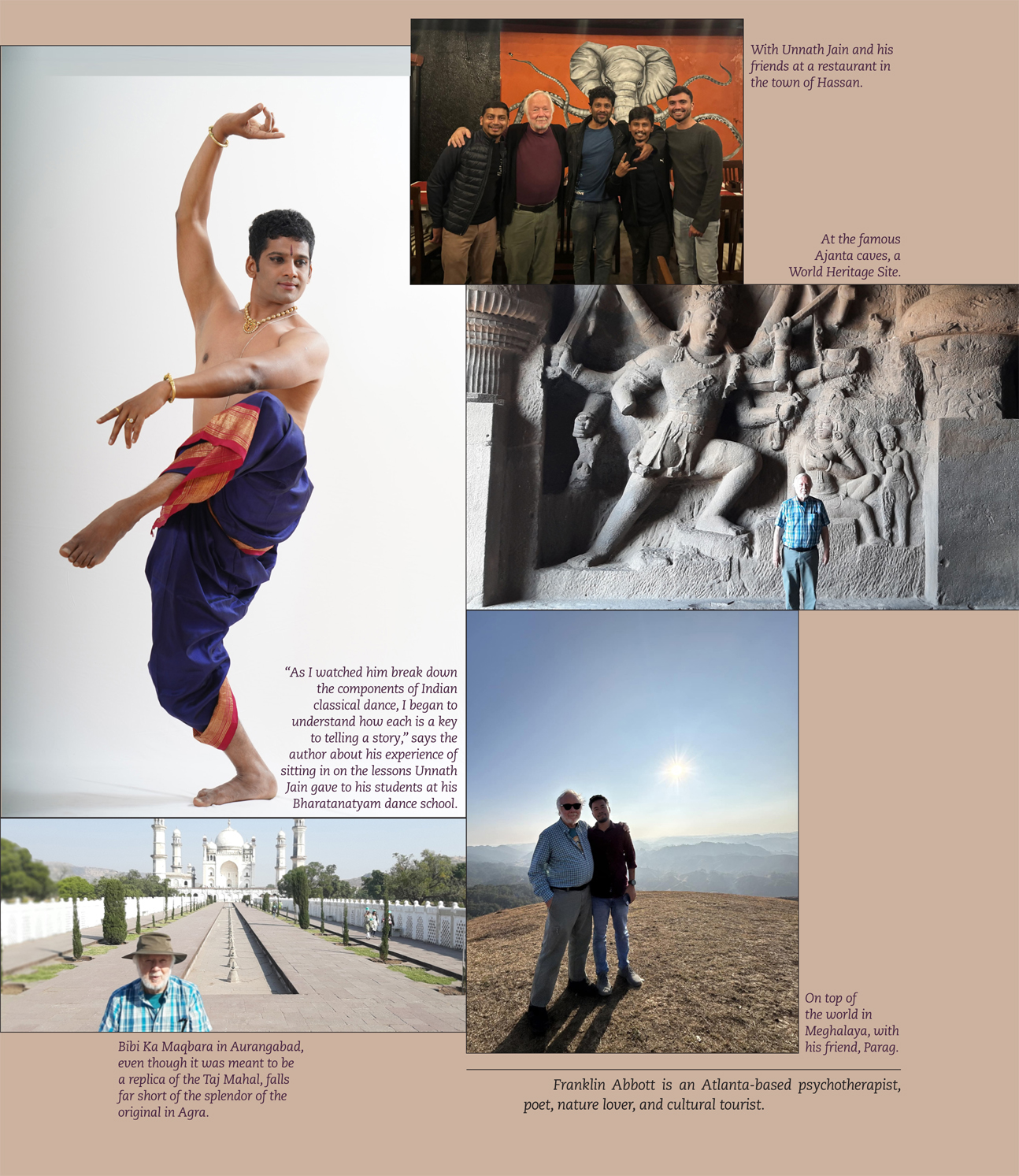
Franklin Abbott is an Atlanta-based retired psychotherapist, poet, nature lover, and cultural tourist.
Enjoyed reading Khabar magazine? Subscribe to Khabar and get a full digital copy of this Indian-American community magazine.